
Opinion|Videos|March 7, 2025
Personalizing Adjuvant Targeted Therapy in Early-Stage NSCLC
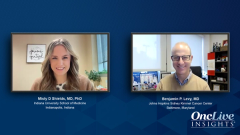
Panelists discuss how, in clinical practice, ADAURA (osimertinib) and ALINA (alectinib) are integrated based on EGFR/ALK status, stage, and recurrence risk. Adjuvant therapy duration is typically 3 years. Circulating tumor DNA (ctDNA), minimal residual disease (MRD) from ADAURA (ASCO 2024, Abs 8005) may refine treatment decisions by detecting MRD.
Advertisement
Episodes in this series
Video content above is prompted by the following:
- How are you incorporating the ADAURA and ALINA regimens into your clinical practice, and what factors influence your patient selection?
- What is your anticipated duration of therapy for patients receiving adjuvant osimertinib or alectinib?
- What is the role of ctDNA in early-stage NSCLC, and how may it guide adjuvant therapy decisions? (MRD analysis from ADAURA: John T, ASCO 2024. Abs 8005.
Advertisement
Related to this article

The top 5 OncLive TV videos of the week cover insights in NSCLC, HER2+ gastroesophageal cancer, low-grade glioma, HR+ breast cancer, and CML.

The FDA approved giredestrant plus everolimus in ESR1-mutated breast cancer and neladalkib in ALK+ NSCLC, issued a CRL to ivonescimab, and more.

Did you catch all of this week's top oncology news? Test your knowledge with OncLive's Weekly News Quiz.

The EC approved every-6-week maintenance dosing and shorter 350-mg infusions for cemiplimab across all 6 EU indications.

Faculty convened at an OncLive Scientific Interchange and Workshop to guide oncology fellows through designing a cancer clinical trial development program, from concept to approval.
Narek Shaverdian, MD, outlines how novel strategies may reshape unresectable stage III NSCLC management.
In case you missed any, read a recap of the episodes of OncLive On Air that aired in October 2026.

The FDA granted fast track designation to elticertinib for pretreated EGFR exon 20 insertion–mutated NSCLC.
Advertisement
Advertisement
Trending on OncLive
1
Lifileucel Shows Feasibility and Promise in Sarcoma
2
Dr Sallman on How Bleximenib Compares With Other Menin Inhibitors in R/R AML
3
New Data Reinforce the Strength of TKIs in Advanced GIST
4
SAR445877-Based Treatment Could Pave the Way for Immunotherapy Activity in MSS CRC
5