
Oncology care thrives on teamwork, emphasizing patient education and communication to manage treatment-related ocular toxicities effectively.
Oncology care thrives on teamwork, emphasizing patient education and communication to manage treatment-related ocular toxicities effectively.
Explore the differences in supportive care for antibody-drug conjugates and their impact on ocular health in patients.
Experts discuss the importance of monitoring ocular toxicities in cancer treatment, emphasizing timely interventions and effective communication between oncologists and ophthalmologists.
Experts discuss the alignment of clinical trial data with real-world experiences in managing ocular toxicities in cancer treatments.
Explore the roles of optometrists and ophthalmologists in managing ocular toxicities, ensuring timely patient care and effective treatment strategies.
Experts discuss the challenges of ocular toxicities in oncology, emphasizing collaboration and the importance of preservative-free eye drops for patient care.
Experts discuss the challenges of ocular toxicities in oncology, emphasizing collaboration and the importance of preservative-free eye drops for patient care.
Explore the latest insights on antibody-drug conjugates in oncology and their associated ocular toxicities, enhancing patient care and treatment outcomes.
Medical oncologists explore the importance of ophthalmology referrals for ocular toxicities, emphasizing collaboration for optimal patient care.
Ophthalmologists discuss the importance of grading dry eye symptoms and the necessity of eye exams before starting certain treatments.
Experts discuss the integration of ocular toxicity management in solid tumor care, focusing on antibody-drug conjugates and their impact on treatment.
Ocular toxicities from cancer treatments present complexities; understanding symptoms and timely ophthalmology involvement is crucial for effective management.
Experts discuss the integration of ocular toxicity management in solid tumor care, focusing on antibody-drug conjugates and their impact on treatment.
Panelists discuss the most common adverse events associated with PARP inhibitor (PARPi) therapy in ovarian cancer and strategies for mitigating or managing these adverse effects. They also review recent data on antibody-drug conjugates (ADCs) in ovarian cancer, including the evolving role of mirvetuximab soravtansine in the FORWARD II trial, and other ADCs such as luveltamab tazevibulin and rinatabart sesutecan, highlighting promising findings from studies presented at ESMO 2024. The session concludes with a discussion on future perspectives in ovarian cancer treatment, offering insights into emerging therapies and the evolving landscape.
Panelists discuss PARP inhibitor resistance in ovarian cancer and explore strategies to overcome this challenge, including findings from the PRESERVE-004 trial evaluating gotistobart plus pembrolizumab, along with other potential treatment options. Additionally, they review insights from the SOPRANO trial regarding the management of oligometastases or oligoprogression in ovarian cancer.
Panelists discuss the implications of PFS and OS data from the PRIMA trial evaluating niraparib as first-line maintenance therapy in advanced ovarian cancer, and the impact of these findings on the treatment paradigm, as well as new insights from the GEICO-88R study on long-term responders to niraparib. They also explore emerging maintenance strategies, including IO combination therapies and hormonal therapies, with a focus on ongoing trials such as rucaparib plus nivolumab, atezolizumab plus bevacizumab, and olaparib plus cediranib.
Panelists discuss how the duration of PARP inhibitor (PARPi) therapy typically differs between the first-line and second-line settings in advanced ovarian cancer treatment.
Panelists discuss how frontline maintenance therapy options for advanced ovarian cancer are influenced by key factors, such as a patient’s HRD status, and when a combination approach with PARP inhibitors and bevacizumab might be preferred over monotherapy.
Panelists discuss how genomic instability scores, including HRD vs HRP profiles, influence treatment selection and sequencing in ovarian cancer, particularly in guiding the use of PARP inhibitors and other targeted therapies in the maintenance setting, and how these scores may prompt adjustments to standard treatment approaches.
Panelists discuss how biomarker testing for advanced ovarian cancer, including when and which biomarkers to test (such as HRD), plays a crucial role in guiding treatment decisions and personalizing patient care.
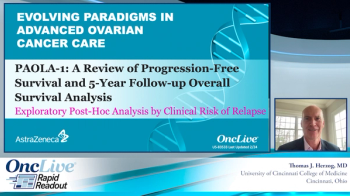
Thomas J. Herzog, MD, examines the PAOLA-1 trial results, focusing on the primary endpoint of progression-free survival (PFS) and key secondary endpoint of overall survival for olaparib in combination with bevacizumab for the treatment of advanced ovarian cancer. He discusses the 5-year overall survival data in relation to the PFS data and reviews the safety profile of the combination therapy with over 5 years of median follow-up. Dr. Herzog also considers the impact of these data on clinical decision-making and patient counseling from the perspective of a practicing gynecologic oncologist.
Panelists discuss clinical guidelines recommendations for HRD testing in ovarian cancer and how they inform their practice.
Discussion centered around data from the PAOLA-1 trial, highlighting the prevalence of BRCA1/2 mutations and HRD status in ovarian cancer, and how patients with these alterations may benefit from PARP inhibitor treatment.
The panel reviews commercially available HRD tests and expand upon factors that may influence test choice, such as clinical performance, institutional availability, turnaround time, and cost.
Dr Hagemann explains how loss of heterozygosity (LOH), large-scale state transitions (LSTs), and telomeric allelic imbalance (TAI) can also contribute to HRD.
Experienced clinicians explain the role of the homologous recombination repair (HRR) pathway in DNA repair and how mutations in HRR-related genes, including BRCA1 and BRCA2, can cause homologous recombination deficiency (HRD) and contribute to the development and progression of ovarian cancer (OC).
Thomas Herzog, MD, Thomas Krivak, MD, and Ian Hagemann, MD, PhD open their discussion by introducing themselves and the objectives of the program.
December 11th 2024
December 25th 2024
July 20th 2023
December 4th 2024
July 27th 2023