





Breast Cancer
Latest News
Advertisement
Latest Videos





































































Advertisement
More News

Results from a meta-analysis of data collected from 837 premenopausal women undergoing chemotherapy for early-stage breast cancer suggest that gonadotropin-releasing hormone analog may preserve fertility and have a protective ovarian function.

Charles Coombes, MD, professor of medical oncology, Imperial College London, discusses surprising results from a recent study examining celecoxib’s impact on breast cancer progression and relapse.
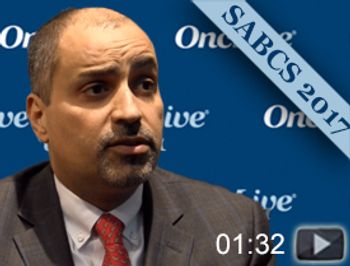
Mothaffar F. Rimawi, MD, associate professor and director of clinical research at the Lester and Sue Smith Breast Center at Baylor College of Medicine, discusses the clinical need for immunotherapy regimens for patients with HER2-positive breast cancer.

Newly released results from the MONALEESA-7 trial showed that adding ribociclib to standard endocrine therapy with temporary ovarian suppression significantly improved progression-free survival as a first-line treatment for pre- and perimenopausal women with advanced HR-positive/HER2-negative breast cancer.
Julie R. Nangia, MD, assistant professor of medicine, Baylor College of Medicine, discusses some logistical factors that oncologists and health care providers should know regarding implementing a scalp cooling system.

The combination of pembrolizumab and trastuzumab reached an objective response rate of 15.2% in patients with trastuzumab-resistant, PD-L1–positive, HER2-positive breast cancer.

Shortening the intervals between chemotherapy cycles or administering the drugs sequentially reduced early-stage breast cancer recurrence and mortality compared with standard dosing techniques.

Treatment with sacituzumab govitecan elicited an objective response rate of 34% in patients with heavily pretreated metastatic triple-negative breast cancer.

Hope S. Rugo, MD, discusses a variety of agents for the treatment of patients with ER-positive breast cancer, such as mTOR inhibitors, PI3K inhibitors, and CDK4/6 inhibitors, in addition to novel targeted therapies being investigated in TNBC.

Melanie Majure, MD, discusses the optimal role chemotherapy for patients with TNBC and the importance of achieving a pCR.
The FDA has approved the trastuzumab (Herceptin) biosimilar MYL-1401O (Ogivri; trastuzumab-dkst), which now has has approved indications for HER2-positive patients with breast or metastatic gastric or gastroesophageal junction adenocarcinoma.
Denise A. Yardley, MD, senior investigator of breast cancer research, Sarah Cannon Research Institute, discusses the BOLERO-2 results for patients with hormone receptor (HR)-positive breast cancer.

Patrick Borgen, MD, discusses the importance of neoadjuvant therapy in the treatment of patients with HER2-positive breast cancer.
Lajos Pusztai, MD, professor of medicine, chief of Breast Medical Oncology, Yale Cancer Center and Yale School of Medicine, discusses the challenges facing neoadjuvant treatment of patients with HER2-positive breast cancer

Sara M. Tolaney, MD, discusses the state of adjuvant treatment for patients with HER2-positive breast cancer.

Lajos Pusztai, MD, discusses neoadjuvant and adjuvant treatment decisions for patients with HER2-positive breast cancer, as well as the potential of immunotherapy in the metastatic setting.

Richard S. Finn, MD, discusses the evolution of CDK 4/6 inhibition in the field of breast cancer and appropriate patient selection for this type of therapy.

Michelle E. Melisko, MD, clinical professor of medicine, University of California, San Francisco (UCSF), explains the discussion around duration of use of aromatase inhibitors in patients who have estrogen receptor-positive breast cancer.

Patrick Borgen, MD, chair, Department of Surgery, director, Breast Center, Maimonides Medical Center, discusses advancements in the treatment landscape of HER2-positive breast cancer.
Although hormone-targeting therapies have been a long-established strategy for the treatment of estrogen receptor (ER)-positive breast cancer, more than 20% of patients with early-stage disease relapse and those who progress to a metastatic stage eventually die from their illness.

The FDA has approved fulvestrant (Faslodex) for use in combination with the CDK4/6 inhibitor abemaciclib (Verzenio) to treat patients with HR+/HER2- advanced or metastatic breast cancer who have progressed after endocrine therapy.

Hope Rugo, MD, professor of medicine, director of the Breast Oncology Clinical Trials Program, UCSF Helen Diller Family Comprehensive Cancer Center, discusses immunotherapy in triple-negative breast cancer.
Advertisement
Advertisement
Trending on OncLive
1
FDA Approves Tucatinib Plus Trastuzumab/Pertuzumab as First-Line Maintenance in Advanced HER2+ Breast Cancer
2
FDA Grants Breakthrough Device Designation to Natera’s Multi-Cancer Early Detection Assay
3
Five Under 5: Top Oncology Videos for the Week of 10/5/2026
4
GI Cancer Monthly Rewind: Key News and Expert Insights You May Have Missed in September 2026
5