




Precision Medicine in Oncology®
Latest News

FDA Approves Dabrafenib Plus Trametinib for Pediatric Patients With BRAF V600E–Mutated Low-Grade Glioma
By Chris Ryan
Advertisement
Latest Videos





































































Advertisement
More News
Adjuvant osimertinib and other targeted therapies, such as KRAS G12C inhibitors, could continue to change the perioperative treatment landscape in non–small cell lung cancer.
The FDA has placed a clinical hold on a phase 1 trial investigating the antibody-drug conjugate XMT-2056 for the treatment of patients with advanced/recurrent solid tumors that express HER2.
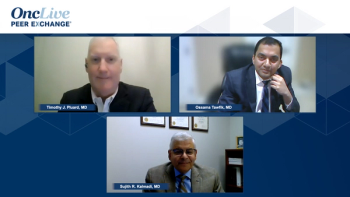
Closing out their discussion on biomarkers and precision medicine in cancer care, key opinion leaders look toward future evolutions in the oncology landscape.

Ryan Haumschild, PharmD, MS, MBA, reflects on how oncologic pharmacists can help to develop treatment pathways and educate patients on precision medicine.

Patients with metastatic castration-resistant prostate cancer have traditionally been burdened by a poor outlook; however, emerging therapeutic targets and novel agents directed at them are poised to affect change in this population.
Precision medicine has arrived in all stages of prostate cancer care and recommendations for optimal testing and how best to leverage the results to inform clinical decisions continue to rapidly evolve.

Lisa M. Carey, MD, ScM, FASCO, discusses upcoming treatments that could impact standard-of-care practices and the continually evolving role of antibody-drug conjugates role in the breast cancer treatment paradigm.
Susan M. Domchek, MD, highlights key points related to her presentation on germline testing and breast cancer treatment.

An understanding of BET protein dysregulation, which leads to abnormal expression of oncogenes, has prompted investigators to explore the idea of these proteins as a therapeutic target for cancer.
Eleni Efstathiou, MD, PhD, expands on the updated interim data from the MAGNITUDE trial and sheds light on the utility of PARP inhibitor combinatorial strategies in patients with mCRPC and HRR gene alterations.

The FDA has approved the VENTANA PD-L1 assay for expanded use in patients with advanced non–small cell lung cancer to help identify patients who may be candidates for treatment with cemiplimab.
Lasofoxifene improved vaginal/vulvar symptoms compared with fulvestrant in premenopausal patients with locally advanced or metastatic estrogen receptor–positive/HER2-negative breast cancer harboring an ESR1 mutation.
The antibody-drug conjugate trastuzumab deruxtecan met the prespecified target for objective response rate and demonstrated durable responses in heavily pretreated patients with HER2-expressing advanced solid tumors in the phase 2 DESTINY-PanTumor02 trial.
Expert perspectives on the role of an oncologic pharmacist within a tumor board and how they can improve upon precision medicine in cancer management.
Comprehensive discussion on the role of tumor boards—or more specifically, molecular tumor boards—in the optimal management of patients with cancer.

Neville E. Sanjana, PhD, discusses a study on the predictive utility of the Cancer Immunotherapy Response CLassifiEr in advanced-stage cancers.

Key opinion leaders in the field of cancer management discuss resistance to the uptake of biomarker testing and precision medicine, with deference to the community setting.
Expert pathologist Samuel K. Caughron, MD, FCAP, shares best strategies for the timing and utilization of biomarker testing while managing patients with cancer.
Andrew Ip, MD, delivers a keynote on the role for liquid biopsy and NGS in hematologic malignancies, including the barriers to implementing seamlessly into clinical practice.

Shubham Pant, MD, MBBS, discusses significant efficacy and safety data from the RAGNAR trial, how erdafitinib fits into the current treatment paradigm for biliary tract cancers, and the role of next-generation sequencing in the selection of FGFR inhibitors for this patient population.
Timothy J. Pluard, MD; Ossama Tawfik, MD; and Sujith R. Kalmadi, MD, reflect on how they update their biomarker testing strategies as the field of cancer care and precision medicine evolves.
Expert perspectives on the wide array of biomarker testing modalities available to patients receiving treatment for cancer.

Sanjay Goel, MD, MS, discusses the evolution of precision and personalized medicine in cancer care.

In this second episode of OncChats: Traveling Through the Lung Cancer Treatment Paradigm, Aaron Franke, MD, discusses the need for additional circulating biomarkers beyond PD-L1 in non–small cell lung cancer.
Comprehensive discussion on how best to interpret and document results from biomarker testing, along with considerations for communicating results with other healthcare professionals.
Advertisement
Advertisement
Trending on OncLive
1
Ifinatamab Deruxtecan BLA Voluntarily Withdrawn in Previously Treated Extensive-Stage SCLC
2
Etentamig Improves Response and PFS vs Standard Therapies in Triple-Class Exposed Relapsed/Refractory Myeloma
3
Dr Voorhees on Eligibility Criteria for the CERVINO Trial in Multiple Myeloma
4
FDA Approves Lirafugratinib for Pretreated, Locally Advanced or Metastatic Cholangiocarcinoma
5