



Head & Neck Cancers
Latest News
Advertisement
Latest Videos




































































Advertisement
More News

Dacomitinib holds promise for the treatment of metastatic or recurrent squamous cell carcinoma of the head and neck (SCCHN).
The FDA has issued a drug safety communication regarding the risk of intoxication with the intravenous ethanol-containing chemotherapy docetaxel.
Martin Schlumberger, MD, Institut Gustave Roussy, Villejuif Cedex, professor of oncology, University Paris-Sud, France, discusses the takeaway points for a community oncologist from the SELECT trial.
The FDA has approved the radioactive diagnostic imaging agent Lymphoseek (technetium 99m tilmanocept) Injection to guide sentinel lymph node biopsy in patients with cancer of the head and neck.

Lenvatinib, a novel multityrosine kinase inhibitor, is highly effective against differentiated thyroid cancer that has become resistant to standard RAI therapy.

Patients with less aggressive, HPV-positive oropharyngeal cancer can be effectively treated with a lower-dose radiation regimen depending upon their response to combination induction therapy.

Nagashree Seetharamu, MD, assistant professor, Medicine (Hematology and Medical Oncology), Perlmutter Cancer Center at NYU Langone, discusses the possibility of using immunotherapy agents to treat head and neck cancers.

Everett E. Vokes, MD, was recognized by the "Giants of Cancer Care" awards program for his groundbreaking research into head and neck cancers.
Doxepin rinse may prove to be a viable option for the relief of pain associated with oral mucositis (OM) in patients with head and neck cancers, according to findings of a phase III trial.
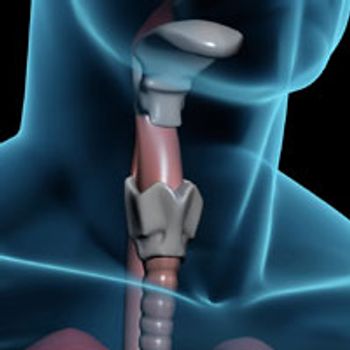
A review study of trends in patients diagnosed with thyroid cancer from 1975 to 2009 suggest the cancer has been overdiagnosed, and therefore overtreated, according to Louise Davies, MD, MS, and H. Gilbert Welch, MD, MPH.

Intensity-modulated radiation therapy (IMRT) improved survival and reduced toxicities compared with conventional radiation treatment in patients with head and neck cancer, according to a recent database analysis.
The phase III SELECT trial of the investigational agent lenvatinib (E7080) met its primary endpoint of progression-free survival (PFS) in patients with radioiodine-refractory differentiated thyroid cancer (RR-DTC), according to Eisai Inc., the company that is developing the agent.

Marcia S. Brose, MD, PhD, from the University of Pennsylvania, discusses the treatment of anaplastic thyroid cancer (ATC) and the FACT2 study.

Alterations in specific genes involved in the formation of tissues and organs during embryonic development could be responsible for survival disparities seen between African-American and non-Latino white men with head and neck cancer.

The FDA has granted a Fast Track designation to Lymphoseek (technetium Tc99m tilmanocept) as a radioactive diagnostic imaging agent for sentinel lymph node detection in patients with head and neck cancer.
Following a fast track designation from the FDA earlier this year, a phase II clinical trial is being initiated to evaluate SGX942 as a treatment for oral mucositis in patients with head and neck cancer.

Marcia S. Brose, MD, PhD, assistant professor, Abramson Cancer Center, Department of Otolaryngology, Head & Neck Surgery, Department of Medicine, Division of Hematology/Oncology, Department of Dermatology, University of Pennsylvania, describes the DECISION trial, which analyzed the efficacy of sorafenib in differentiated thyroid cancer.

Marcia Brose, MD, sat down with OncLive at the Chemotherapy Foundation Symposium in New York City to discuss recent advances in the treatment of thyroid cancer.

The FDA has expanded the approval for sorafenib to include the treatment of patients with RAI-resistant metastatic differentiated thyroid cancer, based a substantial prolongation in PFS over placebo in the DECISION trial.

Head and neck cancer patients who participated in a swallow preservation protocol were less likely to suffer from the detrimental effects associated with dysphagia, a common complication associated with radiation therapy and chemoradiation therapy.

A new test has been developed to identify the difference between malignant and benign nodules in the thyroid gland, which could potentially reduce the number of unnecessary surgeries, according to an announcement from The University of Pittsburgh Schools of the Health Sciences.
Marcia S. Brose, MD, PhD, assistant professor, Abramson Cancer Center, Department of Otolaryngology, Head & Neck Surgery, Department of Medicine, Division of Hematology/Oncology, Department of Dermatology, University of Pennsylvania, discusses recent advances in papillary thyroid cancer.
Hyperfractionated radiotherapy improved overall survival rates compared to standard and accelerated radiotherapy when administered without concomitant chemotherapy in patients with locally advanced head and neck squamous cell carcinoma.
In a phase II clinical trial, the BRAF inhibitor vemurafenib demonstrated antitumor activity in patients with BRAFV600E-mutated papillary thyroid cancer who were either TKI treatment naïve or had received prior TKI treatments.

A meta-analysis of nearly 2000 patients has shown that physical activity may substantially reduce the risk of developing esophageal cancer, especially esophageal adenocarcinoma.
Advertisement
Advertisement
Trending on OncLive
1
FDA Approves Nogapendekin Alfa Inbakicept Plus BCG for High-Grade, Papillary-Only BCG-Unresponsive NMIBC
2
SurVaxM Cancer Vaccine Shows Clinically Meaningful OS Signal in Newly Diagnosed Glioblastoma
3
VS-7375 Elicits Responses in KRAS G12D–Mutated Pancreatic Cancer
4
FDA Accepts BLA Resubmission for Tabelecleucel in EBV+ Post-Transplant Lymphoproliferative Disease
5