





Lung Cancer
Latest News
Advertisement
Latest Videos



































































Advertisement
More News
This publication reviews the role of single-agent and dual immunotherapy for the treatment of metastatic non-small-cell lung cancer, recapping key insights from a scientific interchange & workshop.

The China National Medical Products Administration has approved osimertinib for use as an adjuvant treatment in patients with early-stage non–small cell lung cancer with EGFR exon 19 deletions or exon 21 mutations, following tumor resection with curative intent, with or without adjuvant chemotherapy as recommended by the patient’s physician.

Plasma-based cell-free DNA appears to be a viable strategy comparable with tissue-based testing for selecting patients with KRAS G12C–mutant non–small cell lung cancer for treatment with sotorasib.

The majority of independently adjudicated interstitial lung disease cases associated with fam-trastuzumab deruxtecan-nxki were low grade and occurred within the first 12 months of treatment, with lower risk of developing the effect observed in patients who were on the drug for longer than 1 year.
On February 3, 2021, OncLive® brought together a group of oncologists who specialize in the treatment of lung cancer to participate in a virtual workshop to discuss the emerging treatment landscape of targeted therapies in NSCLC. This article summarizes key data about KRAS G12C as a therapeutic target as well as insights from stakeholder discussions regarding this topic.

Telisotuzumab vedotin monotherapy demonstrated a promising objective response rate and has a tolerable safety profile in patients with previously treated c-Met–positive advanced non–small cell lung cancer.
Treatment with D-0316 demonstrated encouraging clinical activity in select patients with EGFR T790M-positive non–small cell lung cancer who progressed on prior therapy.

Administering the investigational TKI poziotinib at a twice-daily dose compared with once-daily dosing showed a reduction in both grade 3 or higher treatment emergent adverse effects and dose interruptions, as well as improved efficacy in patients with EGFR- or HER2 exon 20–positive non–small cell lung cancer.
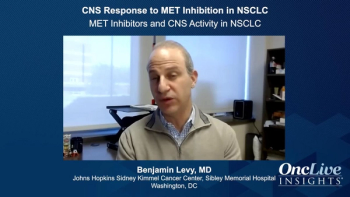
The significance of using MET inhibitors to manage patients who have MET exon 14 skipping mutations in non–small cell lung cancer with CNS (central nervous system) involvement.
Implications for treating patients with non–small cell lung cancer who harbor MET exon 14 skipping mutations with tepotinib, a MET inhibitor, based on data revealed by the VISION trial.
Patients with non‒small cell lung cancer whose circulating tumor MET Exon 14 is undetectable following treatment with savolitinb are more likely to have positive outcomes.

Zenocutuzumab has been shown to block the growth and cause the death of NRG1 fusion–positive cell lines, and to induce tumor shrinkage and durable tumor regression in multiple cancers when used in NRG1 fusion–positive patient-derived xenografts.

Xiuning Le, MD, PhD, discusses the safety findings of the phase 2 ZENITH20-5 study with poziotinib in patients with EGFR- or HER2 exon 20–positive non–small cell lung cancer.

Benjamin Besse, MD, discusses the results of an ad-hoc safety analysis of the phase 1/2 LIBRETTO-001 trial, which examined the use of selpercatinib in patients with RET-altered advanced medullary thyroid cancer and non–small cell lung cancer.

Thomas Urban Marron, MD, PhD, discusses primary objectives of a study examining the use of an adjuvant personalized neoantigen peptide vaccine in several malignancies.

Neoadjuvant treatment with nivolumab combined with chemotherapy led to a significant improvement in pathologic complete response compared with chemotherapy alone in patients with resectable non–small cell lung cancer.

Nicholas C. Rohs, MD, Isabel Preeshagul, DO, MBS, and Joshua K. Sabari, MD, discuss the significance of molecular testing in clinical practice and the evolution of liquid biopsies in lung cancer treatment.

Nicholas C. Rohs, MD, Isabel Preeshagul, DO, MBS, and Joshua K. Sabari, MD, discuss promising agents in the treatment of patients with non–small cell lung cancer with MET amplification.

Nicholas C. Rohs, MD, Isabel Preeshagul, DO, MBS, and Joshua K. Sabari, MD, discuss the latest findings in KRAS G12C–positive non–small cell lung cancer.
Nicholas C. Rohs, MD, Isabel Preeshagul, DO, MBS, and Joshua K. Sabari, MD, discuss data from the IASLC 2020 World Conference on Lung Cancer focused on EGFR-positive non–small cell lung cancer.

Thoracic Night Live is devoted to spotlighting the biggest topics in lung cancer and pivotal studies discussed at medical meetings throughout the year.

Investigators have launched the Epidemiology of Young Lung Cancer study to identify risk factors that can help shed light on why lung cancer develops in the younger population.
Dr. Weiss discusses the significance of the FDA approval of trilaciclib in extensive-stage small cell lung cancer and key efficacy and safety data that have been reported with the CDK4/6 inhibitor.

Edward B. Garon, MD, discusses immunotherapy treatment considerations for patients with non–small cell lung cancer.

Nisha A. Mohindra, MD, discusses the integration of lurbinectedin into the small cell lung cancer paradigm and remaining questions regarding future therapeutic directions.
Advertisement
Advertisement
Trending on OncLive
1
Five Under 5: Top Oncology Videos for the Week of 10/5/2026
2
Guardant360 CDx Receives European Approval as Companion Diagnostic for Camizestrant in ESR1-Mutated Advanced Breast Cancer
3
GI Cancer Monthly Rewind: Key News and Expert Insights You May Have Missed in September 2026
4
Armenia Grants First Marketing Authorizations to Botensilimab Plus Balstilimab in Previously Treated MSS mCRC
5