
Lung Cancer
Latest News
Advertisement
Latest Videos































































Advertisement
More News

Brigatinib reduced the risk of disease progression or death versus crizotinib in adult patients with locally advanced or metastatic ALK-positive non–small cell lung cancer who had not received a prior ALK inhibitor.

Jessica Bauman, MD, addresses current and emerging therapeutic options for patients with BRAF, ROS1, and RET abnormalities in non–small cell lung cancer.

John A. Kosteva, MD, discusses the adoption of immunotherapy into the treatment paradigm for patients with non–small cell lung cancer.

Although impressive single-agent data have been seen with agents such as pembrolizumab (Keytruda) versus chemotherapy in a high–PD-L1 population, the combination of PD-L1 inhibitors and chemotherapy may prove to be beneficial in a broader group of patients.

A review of available evidence has led the American Society for Radiation Oncology to issue a strong recommendation for use of concurrent chemotherapy with thoracic external beam radiation therapy in a subset of patients with incurable stage III non–small cell lung cancer.
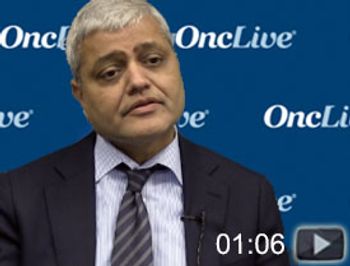
Sanjiv S. Agarwala, MD, chief of medical oncology and hematology, St. Luke’s Cancer Center, professor of medicine, Temple University School of Medicine, discusses the impact of combining entinostat with pembrolizumab (Keytruda) across a number of tumor types.
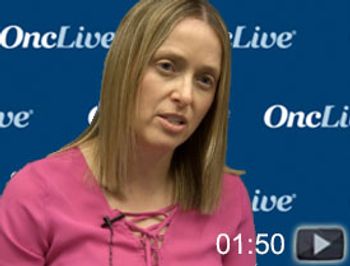
Leora Horn, MD, associate professor of medicine (hematology and oncology), assistant director, educator development program, clinical director, Thoracic Oncology, medical oncologist, Vanderbilt-Ingram Medical Center, discusses selecting the necessary inhibitor for patients with ALK-positive non-small cell lung cancer.

Leonid Shunyakov, MD, hematologist/oncologist, Central Care Cancer Center, discusses the impact of next-generation sequencing (NGS) in oncology.

Adding atezolizumab to pemetrexed and cisplatin or carboplatin in the frontline setting reduced the risk of disease progression or death versus chemotherapy alone in patients with advanced nonsquamous non–small cell lung cancer, according to findings from the phase III IMpower132 study.

In a groundbreaking study of costs and quality of cancer care among cancer clinics in the state of Washington, investigators found wide disparity in end-of-life care, suggesting that improvements in cost and quality could be attained if treatment centers share information on what works and endeavor to improve.

Suresh A. Ramalingam, MD, reflects on recent data in small cell lung cancer and what is on the horizon in the landscape.
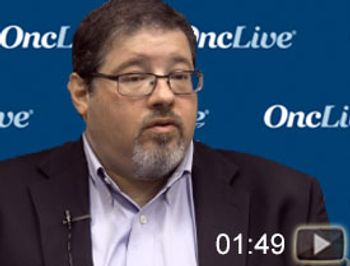
H. Jack West, MD, medical director of thoracic oncology, Swedish Cancer Institute of Swedish Medical Center, discusses the latest immunotherapy findings for lung cancer treatment.

Charu Aggarwal, MD, discusses the latest developments in EGFR-mutant lung cancer.
Benjamin P. Levy, MD, highlights the pros and cons of the different platforms for circulating tumor DNA detection, as well as the benefits and limitations of liquid biopsies.

Liza C. Villaruz, MD, addresses the immunotherapy clinical trials that have informed the treatment of patients with NSCLC and the current state of biomarkers in the field.

Apar Kishor Ganti, MD, professor of internal medicine, Division of Oncology/Hematology, University of Nebraska Medical Center, discusses lung cancer abstracts that were presented at the 2018 ASCO Annual Meeting.

Roy S. Herbst, MD, PhD, professor of Medicine, chief of Medical Oncology, Yale Cancer Center and Smilow Cancer Hospital, discusses the bevacizumab (Avastin) biosimilar in lung cancer.
Advertisement
Advertisement
Trending on OncLive
1
FDA Approves Tucatinib Plus Trastuzumab/Pertuzumab as First-Line Maintenance in Advanced HER2+ Breast Cancer
2
GI Cancer Monthly Rewind: Key News and Expert Insights You May Have Missed in September 2026
3
Five Under 5: Top Oncology Videos for the Week of 10/5/2026
4
FDA Grants Fast Track Designation to PSV359 for Advanced FAP-Positive Solitary Fibrous Tumors
5