




Lung Cancer
Latest News
Advertisement
Video Series


Latest Videos



Shorts

0:50
ASCO 2026 Conference Check-In: With Jonathan Lee, MD, MSc and Manish A. Shah, MD
4 months ago
by
Jonathan Lee, MD, MSc

0:50
ASCO 2026 Conference Check-In: With Jonathan Lee, MD, MSc and Sean Dougherty, MD
4 months ago
by
Jonathan Lee, MD, MSc
3:51
Recapping the ASCO 2026 OncLive Fellows Forum: Lung Cancer
4 months ago
by
Chinmay Jani, MD
3:58
OncLive News Roundup for the Week of 5/17
5 months ago
by
Chris Ryan

4:12
OncLive News Roundup for the Week of 5/3
5 months ago
by
Chris Ryan(+1 more)

4:33
OncLive News Roundup for the Week of 4/26
5 months ago
by
Chris Ryan(+1 more)

4:12
OncLive News Roundup for the Week of 4/12
6 months ago
by
Chris Ryan(+1 more)
4:19
OncLive News Roundup for the Week of 4/5
6 months ago
by
Chris Ryan(+1 more)
1:29
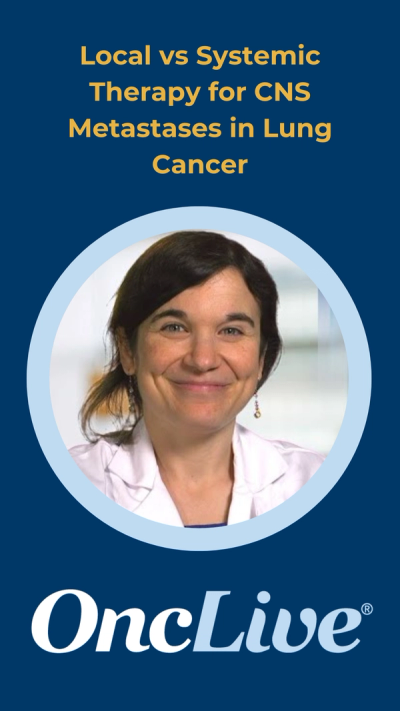
Local vs Systemic Therapy for CNS Metastases in Lung Cancer
7 months ago
by
Laura Alder, MD

3:48
OncLive News Roundup for the Week of 3/8
7 months ago
by
Chris Ryan(+1 more)
Podcasts

































































Advertisement
More News

First data from the phase 1B/2 BNT324-01 trial pair a PD-L1 and VEGF-A bispecific antibody with a B7H3-directed ADC in patients with SCLC.

Every-3-week and every-4-week tarlatamab regimens produced ORRs of 31% and 27% vs 40% with standard bi-weekly dosing in the phase 2 DeLLphi-309 trial.

The FDA approved sevabertinib in first-line HER2-mutant lung cancer, durvalumab plus tarlatamab boosted survival in ES-SCLC, and more.

The dose-finding DeLLphi-308 trial showed promising results for a more convenient administration of tarlatamab in patients with ES-SCLC.

The phase 3 LONESTAR trial was closed early for futility after added local consolidative therapy showed no OS or PFS benefit, including in oligometastatic disease.

Did you catch all of this week's top oncology news? Test your knowledge with OncLive's Weekly News Quiz.

Faculty convened at an OncLive Scientific Interchange and Workshop to discuss HER2-mutant NSCLC testing, treatment selection, and sequencing strategies.

The FDA approved sevabertinib for advanced or metastatic nonsquamous NSCLC harboring HER2 (ERBB2) TKD activating mutations.

Durvalumab plus tarlatamab significantly improved OS and PFS vs durvalumab alone as maintenance in extensive-stage SCLC, per topline phase 3 data.
D. Ross Camidge, MD, PhD, and Eric K. Singhi, MD, preview the SCLC and NSCLC abstracts they are anticipating at the 2026 World Conference on Lung Cancer.
The FDA approved camizestrant for ESR1-mutated breast cancer, cleared ropeginterferon alfa-2b for essential thrombocythemia, and more.
Did you catch all of this week's top oncology news? Test your knowledge with OncLive's Weekly News Quiz.

Daraxonrasib produced a 42% overall response rate and 16.0-month median OS in previously treated RAS-mutant NSCLC in a phase 1/2 trial.

Ivonescimab significantly improved OS vs pembrolizumab at a prespecified interim analysis of the HARMONi-2 trial in first-line PD-L1–positive NSCLC.

Faculty convened at an OncLive Scientific Interchange and Workshop to discuss optimizing first-line treatment selection and second-line sequencing in EGFR-mutated NSCLC.
During a recent OncLive Peer Exchange, panelists discussed testing strategies, updated data, and treatment sequencing in ROS1+ NSCLC.

Two Onc Docs gives a board-focused review of early-stage and locally advanced NSCLC, reflecting recent shifts in staging and perioperative therapy.
The combination met its primary end point in the phase 3 SANOVO trial, though full efficacy and safety data have not yet been reported.
The WVU Heart and Vascular Institute and WVU Cancer Institute performed West Virginia’s first single-port robotic-assisted thoracoscopic lobectomy.
The MHLW approval covers all lines of therapy, including first-line use, in unresectable advanced or recurrent HER2-mutant NSCLC.
UroGen submitted an NDA for UGN-103 in recurrent NMIBC, T-DXd improved PFS in first-line HER2-mutant lung cancer, and more.
Obesity can weaken the immune system and lead to disease progression, but Roswell Park experts revealed that exercise may reverse that effect.

Did you catch all of this week's top oncology news? Test your knowledge with OncLive's Weekly News Quiz.
The oral OMNI-EGFR inhibitor earned fast track status for advanced EGFR C797S–positive non–small cell lung cancer that progressed on a third-generation EGFR TKI.

Topline phase 3 SAFFRON data showed osimertinib plus savolitinib significantly improved PFS and OS vs chemotherapy in MET-driven, osimertinib-resistant EGFR-mutated NSCLC.
Advertisement
Advertisement
Trending on OncLive
1
FDA Approves Tucatinib Plus Trastuzumab/Pertuzumab as First-Line Maintenance in Advanced HER2+ Breast Cancer
2
VIR-5500 Receives FDA Fast Track Designation in mCRPC
3
Iberdomide Plus Daratumumab/Dexamethasone Yields Significant PFS Benefit in R/R Myeloma
4
FDA Approves Atezolizumab Plus Chemo for Stage III dMMR Colon Cancer
5