




Ovarian Cancer
Latest News
Advertisement
Latest Videos





























































Advertisement
More News

The combination of olaparib with the novel AKT-targeting agent AZD5363 generated responses in a variety of tumor types among patients with and without BRCA1/2 mutations, demonstrating that a simultaneous attack on the two pathways is a safe and potentially versatile strategy.

A two-pronged strategy combining the PARP inhibitor olaparib and the PI3K inhibitor BKM120 proved to be a safe and clinically beneficial regimen for women with triple-negative breast cancer and for patients with high-grade serous ovarian cancer.
Clinical trial evidence indicates that some women with high-grade serous ovarian cancer who do not test positive for a BRCA mutation also may respond to olaparib.
Maurie Markman, MD, national director, Cancer Treatment Centers of America, discusses what he sees as future treatment paradigms in ovarian cancer.
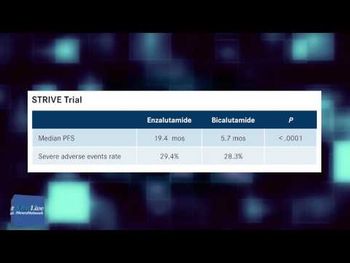
Ursula A. Matulonis, MD, medical director, gynecologic oncology, Susan F. Smith Center for Women's Cancers, institute physician, Dana-Farber Cancer Institute, discusses managing toxicities associated with olaparib for patients with ovarian cancer.

The FDA has granted a breakthrough therapy designation to rucaparib as a treatment for women with BRCA-mutated advanced ovarian cancer who have received at least two prior lines of platinum-based chemotherapy.

Fosbretabulin plus bevacizumab lowered the risk of progression by 31.5% but doubled the rate of hypertension compared with bevacizumab alone in patients with recurrent ovarian cancer.
Treatment with bevacizumab plus a chemotherapy doublet extended overall survival by nearly 5 months compared with chemotherapy alone for women with platinum-sensitive recurrent ovarian cancer.

Treatment with the immunotherapy Vigil delayed time to progression in all patients with stage III/IV ovarian cancer who were treated with the autologous tumor cell vaccine compared with those who were not in an open-label phase II trial.
Analyses of clinical trials continue to illuminate the role of the PARP inhibitor olaparib in the treatment of women with ovarian cancer, according to Ursula A. Matulonis, MD.

BJ Rimel, MD, discuss the current literature surrounding antiangiogenesis agents in ovarian cancer.

In an interview with OncLive, Don Dizon, MD, explains the advantages of IP therapy and why further research and education are necessary to bring it to the forefront of ovarian cancer treatment.

Recent advancements in the treatment of ovarian cancer, including surgical techniques, the approvals of bevacizumab and olaparib, and intraperitoneal chemotherapy, have led the National Comprehensive Cancer Network to make changes to their clinical practice guidelines.

Inhibiting EZH2 may improve outcomes in patients with clear cell ovarian carcinoma who harbor a ARID1A mutation.

OncLive spoke with Sanaz Memarzadeh, MD, on why ovarian and endometrial cancers are so challenging to treat, and what future research is needed to better understand these diseases.

The risk of developing the two most common types of ovarian cancer significantly increases when taking hormone replacement therapy to alleviate symptoms of menopause, according to a meta-analysis of epidemiological studies.
Jason D. Wright, MD, Division Chief, Gynecologic Oncology, Associate Clinical Professor of Gynecologic Oncology, Sol Goldman Associate Professor of Obstetrics and Gynecology, Columbia University, discusses the challenges in measuring progression and recurrence in patients with ovarian cancer.
To gain insight into the integration of olaparib into clinical practice, OncLive interviewed Ursula A. Matulonis, MD, medical director of gynecologic oncology at Dana-Farber Cancer Institute.

The FDA has granted an orphan drug designation to Reolysin for the treatment of patients with ovarian cancer.

For insight on the evolving role of PARP inhibitors in the treatment of ovarian cancer, OncLive interviewed Donna McNamara, MD, co-chief of Gynecological Oncology at the John Theurer Cancer Center (JTCC).

Donna McNamara, MD, Co-Chief of the Gynecologic Oncology Division and Medical Oncologist for the Breast Oncology Division at the John Theurer Cancer Center, talks about the benefits of PARP inhibitors for women with BRCA1 or BRCA2-mutated, platinum-sensitive ovarian cancer.

The New York State Stem Cell Science Program recently awarded a 4-year $11.9 million grant to Roswell Park Cancer Institute to fund research and development of a stem-cell based treatment for ovarian cancer.

Approximately 22,000 women will be diagnosed with epithelial ovarian cancer (EOC) in the United States in 2014, making it the nation's second most common gynecologic malignancy.1 The cancer, which often presents at an advanced stage, causes more deaths than any other type of gynecologic malignancy.

For more than two decades, Kenneth Offit, MD, MPH, has been researching the molecular genetic factors that increase cancer risk, notably concerning germline BRCA mutations in breast and ovarian cancer, with a focus on potential preventive surgical remedies and screening programs for women at hereditary risk.
Advertisement
Advertisement
Trending on OncLive
1
Dr Cercek on the FDA Approval of Dostarlimab for dMMR/MSI-H Locally Advanced Rectal Cancer
2
Vilamakitug Meets OS Threshold in Phase 1/2 Refractory mCRC Trial
3
Weigh Benefit Against Burden: Defining Lurbinectedin’s Role in a Shifting Small Cell Lung Cancer Landscape
4
Dr Warren on the Goal of the 4WARD Trial Evaluating Mavorixafor in Chronic Neutropenia
5