

A post hoc analysis of NAPOLI-3 reveals insights on long-term survivors with pancreatic cancer who received NALIRIFOX.
A post hoc analysis of NAPOLI-3 reveals insights on long-term survivors with pancreatic cancer who received NALIRIFOX.

A fruquintinib regimen appeared safe and effective when used as a frontline treatment in esophageal squamous cell carcinoma.

T-DXd maintained efficacy in HR-positive, HER2-low or -ultralow metastatic breast cancer irrespective of mutational subtype.
Ipatasertib plus fulvestrant extended PFS vs placebo plus fulvestrant in patients with ER-positive/HER2-negative metastatic breast cancer.
Thomas Powles, MD, MBBS, MRCP, shares data from an EFS subgroup analysis from the phase 3 CREST study in BCG-naive, high-risk NMIBC.

Sasanlimab plus BCG led to a PFS benefit vs BCG alone in patients with CIS and T1 high-risk non–muscle invasive bladder cancer.

Amivantamab/chemotherapy demonstrated sustained efficacy, despite the osimertinib resistance mechanism in patients with EGFR-mutated NSCLC.

Zanubrutinib in combination with venetoclax was highly active in patients with untreated chronic lymphocytic leukemia or small lymphocytic lymphoma.
Vincent Picozzi, MD, discusses the addition of TFields to gemcitabine and nab-paclitaxel in locally advanced pancreatic ductal adenocarcinoma.

Patient-reported outcomes revealed that imulunestrant with or without abemaciclib was favored vs SOC in ER-positive, HER2-negative breast cancer.
Durable improvements in transfusion independence and an early indication of potential OS benefit were seen with luspatercept in extended follow-up.

Zilovertamab vedotin plus R-GemOx elicits responses in patients with relapsed or refractory diffuse large B-cell lymphoma.

MK-1084 produced responses and was safe in KRAS G12C–mutated advanced colorectal cancer.
Raffaele Califano, MD, discusses molecularly stratified outcomes amivantamab with chemotherapy vs chemotherapy alone in patients with advanced EGFR-mutant NSCLC.

Jad Chahoud, MD, MPH, MHA, shares early-phase data with zanzalintinib plus nivolumab with or without relatlimab-rmbw in previously untreated ccRCC.
Zanubrutinib retained long-term efficacy as a frontline treatment in CLL/SLL harboring 17p deletions.

Treatment resistance to sotorasib plus panitumumab may stem from genomic alterations in KRAS G12C–mutated CRC.

Nivolumab plus ipilimumab displayed superior PFS and PFS2 data vs chemotherapy and nivolumab monotherapy in mismatch repair-deficient colorectal cancer.
Anlotinib/chemotherapy demonstrated similar responses and PFS outcomes vs bevacizumab/chemotherapy in patients with RAS/BRAF wild-type mCRC.
Adjuvant chemotherapy decisions based on ctDNA status did not improve recurrence-free survival in stage III colon cancer.
T-DXd demonstrated clinically meaningful antitumor responses as second-line treatment in HER2-positive gastric/GEJ cancer.

PFS was improved when patients with ESR1-mutant ER-positive, HER2-negative advanced breast cancer received treatment with vepdegestrant vs fulvestrant.

Frontline sacituzumab govitecan plus pembrolizumab improved PFS vs chemotherapy plus pembrolizumab in PD-L1+ metastatic triple-negative breast cancer.
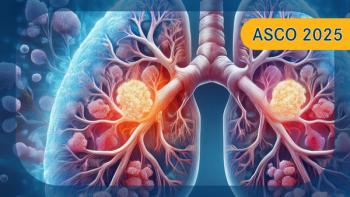
Adjuvant chemotherapy generated a DFS benefit over observation in patients identified as having higher-risk nonsquamous NSCLC per a prognostic assay.
Phase 1 data indicate that KITE-363 represents a promising therapeutic approach for patients with relapsed/refractory B-cell lymphoma.
John H. Strickler, MD, discusses the preliminary efficacy of sotorasib in combination with multiple agents across tumor types harboring KRAS G12C mutations.
PhasED-Seq–assessed ctDNA-based MRD negativity was strongly associated with improved PFS after frontline treatment in patients with DLBCL.
Encorafenib plus cetuximab and mFOLFOX6 improved progression-free survival in BRAF V600E–mutated metastatic colorectal cancer.
A 2025 ASCO press briefing previewed key advances in breast and lung cancer, HER2 diagnostics, and GLP-1s’ link to reduced cancer risk.

GI cancer experts rank key abstracts of interest from the upcoming ASCO Annual Meeting on OncLive’s social media.