Rapid Readouts

Analyses of Minimal Residual Disease (MRD) Negativity Dynamics in the Phase 3 Imroz Study

Dr. Philippe Moreau presents analyses of minimal residual disease (MRD) negativity dynamics from the Phase 3 IMROZ study, highlighting the sustained depth of response, progression-free survival benefits, and reduced MRD relapse rates with isatuximab plus VRd in transplant-ineligible patients with newly diagnosed multiple myeloma.
Elacestrant real-world progression-free survival (rwPFS) of adult patients with ER+/HER2-, advanced breast cancer: a retrospective analysis using insurance claims in the United States

Dr. Aditya Bardia presents real-world findings on elacestrant, demonstrating prolonged real-world progression-free survival (rwPFS) in ER+/HER2- advanced breast cancer patients across all clinically relevant subgroups, with benefits observed particularly in earlier treatment lines and in those without prior fulvestrant exposure.

5-Year Follow-Up of Cohort 1 from the SEQUOIA Study

Dr. Mazyar Shadman presents an OncLive Rapid Readout on the SEQUOIA study, highlighting 5-year follow-up data that confirm zanubrutinib’s sustained progression-free survival superiority over bendamustine plus rituximab in treatment-naive chronic lymphocytic leukemia/small lymphocytic lymphoma, with consistent efficacy across risk groups and a favorable long-term safety profile.

Dr. Bruna Pellini presents key data comparing real-world outcomes of atezolizumab versus durvalumab in extensive-stage small cell lung cancer (ES-SCLC), demonstrating a significant overall survival advantage and lower immune-related adverse events with durvalumab, while progression-free survival remained comparable between the two treatments.

RMC-9805

Dr. David S. Hong presents the preliminary Phase 1 results on RMC-9805, a first-in-class, oral, RAS(ON) G12D-selective inhibitor, highlighting its promising safety, pharmacokinetics, and early antitumor activity in patients with KRAS G12D-mutant pancreatic ductal adenocarcinoma (PDAC), with further dose optimization and combination studies underway.

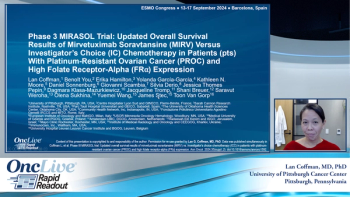
Phase 3 MIRASOL Trial: Updated Overall Survival Results of Mirvetuximab Soravtansine (MIRV) Versus Investigator’s Choice (IC) Chemotherapy in Patients (pts) With Platinum-Resistant Ovarian Cancer (PROC) and High Folate Receptor-Alpha (FR⍺) Expression

Dr. Lan Coffman presents updated Phase III MIRASOL trial results comparing overall survival and safety outcomes of mirvetuximab soravtansine (MIRV) versus investigator’s choice chemotherapy in patients with platinum-resistant ovarian cancer and high folate receptor-alpha expression.

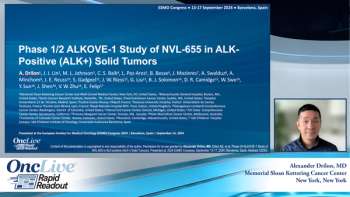
Phase 1/2 ALKOVE-1 study of NVL-655 in ALK-positive (ALK+) solid tumors

Dr. Alexander Drilon presents an update from the Phase 1/2 ALKOVE-1 study, investigating the efficacy and safety of NVL-655, a selective ALK inhibitor, in patients with ALK-positive solid tumors, highlighting durable responses in heavily pre-treated populations, including those with compound ALK resistance mutations and central nervous system involvement.

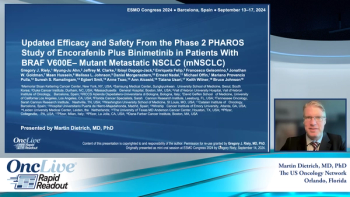
Updated Efficacy and Safety From the Phase 2 PHAROS Study of Encorafenib Plus Binimetinib in Patients With BRAF V600E-Mutant Metastatic NSCLC (mNSCLC)

Dr. Martin Dietrich presents updated efficacy and safety data from the Phase 2 PHAROS study, evaluating encorafenib plus binimetinib in patients with BRAF V600E-mutant metastatic non-small cell lung cancer, showing sustained clinical activity and a consistent safety profile after extended follow-up.

Daratumumab + Bortezomib/Lenalidomide/Dexamethasone in Patients With Transplant-ineligible or Transplant-deferred Newly Diagnosed Multiple Myeloma: Results of the Phase 3 CEPHEUS Study

Dr. Saad Usmani discusses the results of the Phase 3 CEPHEUS study, which evaluated the combination of daratumumab with bortezomib/lenalidomide/dexamethasone (D-VRd) in transplant-ineligible or transplant-deferred patients with newly diagnosed multiple myeloma, highlighting its impact on progression-free survival and minimal residual disease negativity.

Phase 1 trial of DLL3/CD3 IgG-Like T-Cell Engager BI 764532 in Patients with DLL3 Positive Tumors: Patients with LCNEC

Dr. Rafael Fonseca presents the primary results of the phase 3 AURIGA study, which demonstrates the significant improvement in MRD-negative conversion and progression-free survival with subcutaneous daratumumab plus lenalidomide versus lenalidomide alone as maintenance therapy in newly diagnosed multiple myeloma post-transplant, shared at the 2024 International Myeloma Society Annual Meeting.

Phase 1 trial of DLL3/CD3 IgG-Like T-Cell Engager BI 764532 in Patients with DLL3 Positive Tumors: Patients with LCNEC

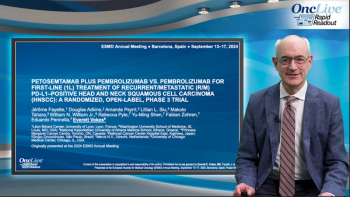
Everett E. Vokes, MD, FASCO, from University of Chicago Medicine, presents interim results from a phase 3 trial comparing petosemtamab plus pembrolizumab versus pembrolizumab monotherapy for first-line treatment of recurrent/metastatic PD-L1-positive head and neck squamous cell carcinoma at the 2024 ESMO Annual Meeting.

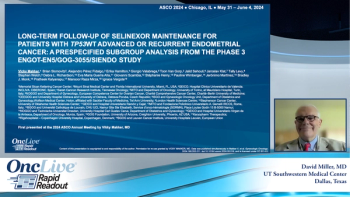
Long-term Follow-up of Selinexor Maintenance for Patients With TP53wt Advanced or Recurrent Endometrial Cancer: A Prespecified Subgroup Analysis From the Phase 3 ENGOT-EN5/GOG-3055/SIENDO Study

David Miller, MD, reviews a plenary presentation (originally presented at the ASCO 2024 Annual Meeting by Vikky Makker, MD) on the long-term follow-up of the ENGOT-EN5/GOG-3055/SIENDO trial, focusing on selinexor maintenance for patients with TP53 wild-type advanced or recurrent endometrial cancer.

Management of Patients With Lower-Risk Myelodysplastic Syndromes (LR-MDS) in a Large US Community Oncology Practice: A Focus on Patient Outcomes Post Erythropoietin Stimulating Agent (ESA) Treatment

The aim of this study is to describe the demographic, clinical, and treatment characteristics of patients with LRMDS who were managed by physicians at Florida Cancer Specialists & Research Institute (FCS) and treated with ESAs, and to determine the proportion of LR-MDS patients who experience ESA failure and describe treatment patterns following ESA failure.