scout

Rapid Readouts

Sacituzumab Govitecan Plus Pembrolizumab vs Chemotherapy Plus Pembrolizumab in Patients With Previously Untreated, PD-L1 Positive, Advanced or Metastatic Triple-Negative Breast Cancer: Primary Results From the Randomized, Phase 3 ASCENT-04/KEYNOTE-D19 Study

Sara Tolaney, MD, MPH, presents primary results from the Phase 3 ASCENT-04/KEYNOTE-D19 study showing that sacituzumab govitecan plus pembrolizumab significantly improved progression-free survival with manageable safety versus chemotherapy plus pembrolizumab in previously untreated PD-L1–positive advanced triple-negative breast cancer.

Chan Y. Cheah, MBBS, DMSc, shares insights on updated results from the phase 1 BGB-11417 trial that were presented at the 2025 EHA Congress in Milan, Italy. The longer follow-up data demonstrate the safety and efficacy of the sonrotoclax plus zanubrutinib combination in patients with relapsed or refractory chronic lympocytic leukemia and small lymphocytic lymphoma.

Austin Kulasekararaj, MBBS, MD, MRCP, FRCPath, presents results from the phase 3b APPULSE-PNH trial at the 2025 EHA Congress in Milan, Italy. The data demonstrate that, in patients with PNH and hemoglobin ≥10 g/dL who switched from anti-C5 therapy to iptacopan, iptacopan was superior in improving hemoglobin levels from baseline.

Raul Cordoba, MD, PhD, presents results from the phase 1 study of sonrotoclax plus zanubrutinib in relapsed/refractory mantle cell lymphoma, highlighting a favorable safety profile with no tumor lysis syndrome or atrial fibrillation, and promising antitumor activity, including a 78% overall response rate and a 70% complete response rate at the recommended dose of 320 mg.

Brian A. Van Tine, MD, PhD, presents results from the first-in-human Phase 1a trial of BG-68501, a selective CDK2 inhibitor, showing early signs of antitumor activity and a manageable safety profile in heavily pretreated patients with advanced solid tumors, including HR+/HER2– breast cancer and ovarian cancer, supporting continued dose escalation and ongoing enrollment.

Andrew J. Armstrong, MD, ScM, FACP, presented 5-year follow-up data from the ARCHES trial showing that enzalutamide plus androgen-deprivation therapy significantly prolonged overall survival versus placebo plus ADT in patients with metastatic hormone-sensitive prostate cancer, with consistent benefit across subgroups and no new safety signals.

Event-free survival (EFS) in MATTERHORN: A randomized, phase 3 study of durvalumab plus 5-fluorouracil, leucovorin, oxaliplatin and docetaxel chemotherapy (FLOT) in resectable gastric/gastroesophageal junction cancer (GC/GEJC)

Presented by Yelena Y. Janjigian at ASCO 2025, the Phase 3 MATTERHORN study demonstrated that adding durvalumab to FLOT significantly improved event-free survival compared with FLOT alone in patients with resectable gastric and gastroesophageal junction adenocarcinoma, with consistent benefit across subgroups and no new safety concerns.

Martin Dietrich, MD, live from the 2025 ASCO Annual Meeting, presents interim results from the phase 1b DAREONTM-9 study, showing that obrixtamig combined with topotecan is well tolerated and demonstrates promising preliminary efficacy in patients with relapsed or refractory small cell lung cancer, with a confirmed overall response rate of 69%.

Xavier Leleu, MD, PhD, presents primary results from the Phase 3 IRAKLIA study demonstrating noninferior efficacy and a favorable safety profile of subcutaneous versus intravenous isatuximab, both combined with pomalidomide and dexamethasone, in patients with relapsed/refractory multiple myeloma.
Alexander Olawaiye, MD, presents results from the phase 3 ROSELLA trial, in which relacorilant combined with nab-paclitaxel significantly improved progression-free and overall survival vs nab-paclitaxel alone in patients with platinum-resistant ovarian cancer, with a manageable safety profile.

Efficacy and safety of the DLL3/CD3 T-cell engager obrixtamig in patients with extrapulmonary neuroendocrine carcinomas with high or low DLL3 expression: results from an ongoing Phase I trial

Jaume Capdevila, MD, PhD, presents results from a phase 1 study showing that obrixtamig monotherapy achieves a 40% response rate and durable disease control with manageable safety in patients with extrapulmonary neuroendocrine carcinoma, particularly those with high DLL3 expression.

Presented by Amer Zeidan, MBBS, this OncLive Rapid Readout highlights results from the phase 2 ASCERTAIN-V trial, in which an all-oral regimen of decitabine-cedazuridine plus venetoclax achieved a 46.5% complete response rate and a median overall survival of 15.5 months in newly diagnosed patients with acute myeloid leukemia who are ineligible for intensive chemotherapy.

Sarah Sammons, MD, presents updated results from the ReDiscover trial at the 2025 ASCO Annual Meeting in Chicago, demonstrating that the mutant-selective PI3Kα inhibitor RLY-2608 in combination with fulvestrant shows promising clinical activity and a manageable safety profile in patients with PIK3CA-mutant HR+/HER2– advanced breast cancer.

Sara Tolaney, MD, MPH, presents results from the phase 3 DESTINY-Breast09 study showing that trastuzumab deruxtecan plus pertuzumab improved progression-free survival vs taxane, trastuzumab and pertuzumab (THP) as a first-line treatment in patients with HER2 positive metastatic breast cancer.

Dr. Lakshmi Nayak presents results from the Phase II PROSPECT study, demonstrating that tirabrutinib monotherapy yields a 66.7% overall response rate and a manageable safety profile in patients with relapsed or refractory primary central nervous system lymphoma, supporting its potential as an effective treatment option in this challenging population.

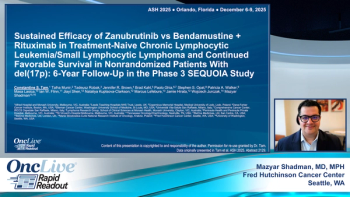
SEQUOIA 5-year Follow-up in Arm C: Frontline Zanubrutinib Monotherapy in Patients with del(17p) and Treatment-naive CLL/SLL

Dr. Constantine S. Tam presents 5-year follow-up results from the SEQUOIA trial, showing that frontline zanubrutinib provides durable progression-free and overall survival with a consistent safety profile in patients with treatment-naïve CLL/SLL, including those with del(17p). Funding supported by BeOne Medicines USA, Inc. Content independently developed by OncLive.

Dr. Kathryn C. Arbour presents preliminary findings from a Phase 1 study showing that zoldonrasib, a selective RAS(ON) G12D inhibitor, demonstrates encouraging antitumor activity and a manageable safety profile in patients with previously treated KRAS G12D–mutant non–small cell lung cancer.

Asciminib Demonstrates Favorable Safety and Tolerability Compared with Each Investigator-Selected Tyrosine Kinase Inhibitor in Newly Diagnosed Chronic Myeloid Leukemia in Chronic Phase in the Pivotal Phase 3 ASC4FIRST Study: Week 96 Update

Dr. Jorge E. Cortes presents updated week 96 results from the Phase 3 ASC4FIRST study, showing that asciminib continues to demonstrate superior efficacy and a more favorable safety profile compared with investigator-selected TKIs in newly diagnosed chronic-phase CML, reinforcing its potential as a standard of care.

ENGOT-EN5/GOG-3055/SIENDO study

Dr. Debra Richardson presents a subgroup analysis of the SIENDO trial, showing that selinexor maintenance therapy significantly improves progression-free survival and delays subsequent treatment in patients with TP53 wild-type advanced or recurrent endometrial cancer, with manageable safety and potential long-term benefit.

Osimertinib after definitive chemoradiotherapy in patients with unresectable stage III EGFRm NSCLC: Updated overall survival analysis from the LAURA study

Suresh S. Ramalingam, MD, FACP, FASCO, presents updated overall survival data from the Phase 3 LAURA study, demonstrating that osimertinib after chemoradiotherapy provides clinically meaningful progression-free survival benefits and favorable survival trends in patients with unresectable stage III EGFR-mutated NSCLC.

Prognostic and predictive role of circulating tumor DNA (ctDNA) in stage III colon cancer treated with celecoxib: Findings from CALGB (Alliance)/SWOG 80702

Dr. Benjamin Weinberg presents findings from a ctDNA-based analysis of the CALGB/SWOG 80702 trial, showing that circulating tumor DNA status may help identify patients with stage III colon cancer who could benefit from celecoxib added to standard adjuvant chemotherapy, offering a potential biomarker-driven approach to personalized treatment.

AGAVE-201

Dr. Catherine Lee presents a post-hoc analysis of the AGAVE-201 trial, demonstrating that axatilimab achieves consistent overall response rates in patients with chronic graft-versus-host disease regardless of prior lines of therapy, with rapid and durable responses, particularly following ruxolitinib, and a favorable safety profile.