
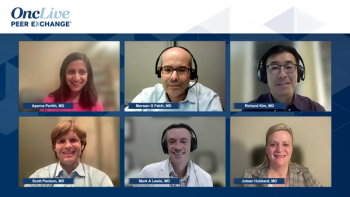
Key safety considerations for the use of fruquintinib are explored.
Key safety considerations for the use of fruquintinib are explored.
Jobelle Baldonado, MD, discusses the evolution of personalized approaches to treatment in non–small cell lung cancer.
The National Comprehensive Cancer Network recommends ropeginterferon alfa-2b as first-line cytoreductive therapy for polycythemia vera.
Ariel Grajales-Cruz, MD, discusses factors associated with benefit from teclistamab in heavily pretreated relapsed/refractory multiple myeloma.
Speculation on anticipated innovations in allo-HSCT and cellular therapy technologies in the future.
The expert panel shares emerging data on an engineered, allogeneic cell-based therapy administered as part of conditioning for allo-HSCT in patients with relapsed, refractory, or high-risk hematologic cancers.
Dae Won Kim, MD, discusses findings from the NAPOLI 3 trial that support the use of NALIRIFOX in patients with metastatic pancreatic cancer.
Dr Parikh drives a conversation surrounding 3L treatment for patients diagnosed with metastatic colorectal cancer.
Medical experts open a discussion providing an update on the current impact of metastatic colorectal cancer and common treatment strategies.
David A. Sallman, MD, discusses the potential use of fedratinib to manage symptomatic myelodysplastic syndrome/myeloproliferative neoplasms.
John M. Bryant, MD, discusses how identifying germline DNA repair mutations may impact the development of targeted therapy development in PDAC.
A panel of experts discuss future directions and remaining unmet needs for patients with relapsed/refractory MCL.

Jobelle Baldonado, MD, highlights the emergence of targeted therapies and the need for reflex-ordered molecular testing in early-stage lung cancer.
Rachid Baz, MD, discusses findings from an analysis of cytopenias and infections in patients with multiple myeloma enrolled in the KarMMa-3 trial.
Criteria for identifying patients with MDS most likely to benefit from transplant and choosing the optimal donor source and conditioning regimen on a case-by-case basis.
A panel of expert oncologists offer closing thoughts on the future treatment landscape and unmet needs in CLL.
Safety and toxicity data from a clinical trial investigating a novel, precision-engineered allo-HSCT conditioning regimen for older patients with high-risk blood cancers.
Expert oncologists explore emerging therapies being investigated in CLL, including BTKi degraders, CAR-T therapy, and bispecific antibodies, and discussed their potential impact in shaping the future of CLL treatment.
Richard Kim, MD, discusses a real-world investigation of long-term responses with regorafenib in metastatic colorectal cancer.
A panel of experts discuss how to sequence BTK inhibitors and CAR T-cell therapies in patients with MCL.
Experts on mantle cell lymphoma discuss third-line treatment options available for patients.
This session will focus on considerations and outcomes of allo-HSCT specifically among patients over 55 years of age. The panel will discuss how transplant protocols and supportive care measures can be optimized for this population who are at higher risk of comorbidities, toxicity and poor functional status.
An overview of promising novel cellular therapies showing efficacy against hematologic cancers in early-phase clinical trials.
The expert panel discusses recent data regarding the mechanisms of resistance to non-covalent BTK inhibitors in CLL.
Jacqueline Barrientos, MD, MS, discusses the role of non-covalent BTK inhibitors in R/R CLL and provided concise comments on the latest data, including insights from the ongoing BRUIN and Bellwave trials.
Teclistamab produced responses in real-world patients with relapsed and refractory multiple myeloma and prior exposure to BCMA-targeted therapy.
Experts on mantle cell lymphoma discuss second-line treatment options available for patients.
A panel of experts review latest data from ASH 2023 on approved and emerging therapies in frontline MCL.
George Simon, MD, FACP, FCCP, discusses the importance of enrolling diverse patient populations in cancer clinical trials.
Bruna Pellini, MD, discusses the importance of developing circulating tumor DNA assays with increased sensitivity.