



Precision Medicine in Oncology®
Latest News
Advertisement
Latest Videos
































































Advertisement
More News

The goal in treating newly diagnosed multiple myeloma is to achieve deep remission and prevent relapse, which is best achieved by targeted combination therapy very early in the course of disease.

Suzanne L. Topalian, MD, has led clinical development of monoclonal antibodies to treat patients with melanoma and other solid tumors, including those targeting the PD-1 T cell co-receptor.

The development of targeted agents aimed at aurora kinases has proceeded slowly, and the future may lie in combination therapies.

Researchers have identified a potential predictive marker for survival in cases of metastatic colorectal cancer treated with bevacizumab.

The latest research on several investigational cancer therapies was presented at the European Society for Medical Oncology 2012 Congress.

David R. Gandara, MD, University of California, Davis Comprehensive Cancer Center, provides his opinion on some of the most exciting research currently taking place for patients with NSCLC.
In order to help community oncologists optimize patient outcomes, this review summarizes clinical issues associated with specific therapies and the background pivotal data.

Founded in 1913 as a tuberculosis sanatorium, City of Hope today enjoys a reputation as a leading research, treatment, and education center for those with cancer, diabetes, and other life-threatening diseases.
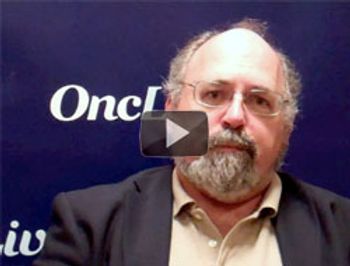
Corey J. Langer, MD, from the Abramson Cancer Center, discusses the investigation of targeted therapies for patients with locally advanced non-small cell lung cancer.
The Trials in Progress section supplies summaries of ongoing research in a broad range of cancer types.

An interview with Elaine R. Mardis, PhD, discussing the clinical applications of genomic research on the near horizon that will enable more personalized therapy for patients at earlier stages of breast cancer.
The heterogeneity of lung tumors generates challenges in terms of the costs and logistics of developing targeted therapies, given that relatively few patients may harbor a particular mutation.

Jeffrey S. Weber, MD, PhD, specializes in cancer immunotherapy and has been involved in numerous trials of clinical drug development, vaccines, and studies on autoimmunity and melanoma.

A thorough personal and family history is the key to determining which patients are candidates for genetic counseling and testing.
D. Ross Camidge, MD, PhD, from the University of Colorado Cancer Center, discusses the ever changing and evolving world of clinical cancer research.
Though located far downstream of the extracellular trigger that initiates its signaling pathway, the MEK protein is no less significant a player in the cascade of events that promotes key cellular processes.

Antoni Ribas, MD, from the UCLA Jonsson Comprehensive Cancer Center, discusses a phase I/II trial combining vemurafenib and ipilimumab for metastatic melanoma.

Novel formulations of specialty drugs have shifted the treatment of patients taking oncologic and biologic agents from infusion centers to the doctor's office.

An interview with Giorgio V. Scagliotti, MD, who has played a prominent role in researching and developing therapies to attack molecular targets.

A new supercomputer-based network will allow physicians to transfer and analyze genomic data more rapidly than standard methods.

Combining the new drugs dabrafenib and trametinib provided a clinically meaningful improvement in patients with melanoma that had BRAF V600 mutations.

Pretreatment serum lactate dehydrogenase is a prognostic factor in poor-risk patients with renal cell carcinoma and also a predictive factor for a survival benefit from treatment with temsirolimus.

A consortium of over 442 global investigators at 32 institutions recently reported results in over 30 publications of a decade of work from the Encyclopedia of DNA Elements project.
The application of molecular markers is already significantly improving the diagnosis of thyroid cancer and broader application could help prevent unnecessary surgeries to confirm the diagnosis.

Four histopathologic features of papillary microcarcinoma help predict how aggressive the tumor will be and subsequently how aggressive treatment must be to prevent its spread.
Advertisement
Advertisement
Trending on OncLive
1
Ifinatamab Deruxtecan BLA Voluntarily Withdrawn in Previously Treated Extensive-Stage SCLC
2
Etentamig Improves Response and PFS vs Standard Therapies in Triple-Class Exposed Relapsed/Refractory Myeloma
3
Dr Voorhees on Eligibility Criteria for the CERVINO Trial in Multiple Myeloma
4
FDA Approves Lirafugratinib for Pretreated, Locally Advanced or Metastatic Cholangiocarcinoma
5