





Chronic Lymphocytic Leukemia
Latest News
Advertisement
Latest Videos























































Advertisement
More News
Chan Y. Cheah, MD, MBBS, discusses the the phase 1 BGB-11417-101 trial, which showed that the BCL-2 inhibitor BGB-11417, administered alone or in combination with the BTK inhibitor zanubrutinib, induced promising response rates and was well tolerated patients with chronic lymphocytic leukemia.

Carsten Niemann, MD, PhD, discusses notable data on patient survival outcomes, as well as the impact of minimal residual disease in the peripheral blood from the phase 3 GLOW trial in patients with chronic lymphocytic leukemia.

Japan’s Ministry of Health, Labor, and Welfare has approved acalabrutinib for the treatment of previously untreated patients with chronic lymphocytic leukemia and small lymphocytic lymphoma.
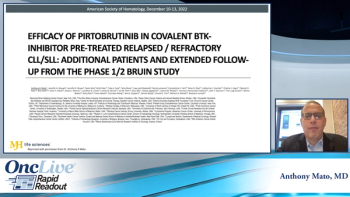
Dr Anthony Mato reviews the extended follow-up results from the phase 1/2 BRUIN Study that evaluated the use of pirtobrutinib in patients with lymphoma.
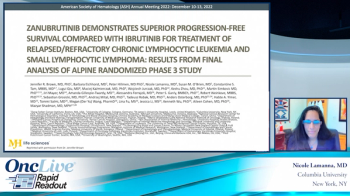
Nicole Lamanna, MD, reviews the results of the phase 3 study evaluating the use of zanubrutinib versus ibrutinib for patients with relapsed/refractory (R/R) chronic lymphocytic leukemia (CLL) and small lymphocytic lymphoma (SLL).

Driven by his twin passions for music and science, Louis M. Staudt, MD, PhD, has made a career out of reading between the notes.

Lisaftoclax alone or in combination with acalabrutinib or rituximab was active across a range of doses and displayed a tolerable safety profile in patients with relapsed/refractory and treatment-naïve chronic lymphocytic leukemia and small lymphocytic lymphoma.

John M. Burke, MD, discusses the underrepresentation of elderly patients in clinical trials for lymphoma.

Carsten Niemann, MD, PhD, discusses ibrutinib plus venetoclax vs chlorambucil and obinutuzumab in mutated chronic lymphocytic leukemia.

Anthony Mato, MD, MSCE, discusses the relapsed refractory setting compared with the frontline setting and promising agents such as pirtobrutinib and zanubrutinib.

BGB-11417, when given alone or in combination with zanubrutinib, elicited encouraging responses and minimal residual disease negativity rates in patients with chronic lymphocytic leukemia or small lymphocytic lymphoma, according to preliminary data from a phase 1 trial.

Treatment with zanubrutinib (Brukinsa) reduced the risk of progression or death by 35% compared with ibrutinib (Imbruvica) for patients with relapsed or refractory chronic lymphocytic leukemia or small lymphocytic lymphoma.

The combination of zilovertamab and ibrutinib resulted in promising clinical response and progression-free survival rates and showcased a tolerable toxicity profile in patients with mantle cell lymphoma and chronic lymphocytic leukemia.

Joanna M. Rhodes, MD, discusses evaluating the unmet needs of elderly patients in CLL.

The European Commission has approved zanubrutinib for the treatment of adult patients with treatment-naïve or relapsed/refractory chronic lymphocytic leukemia.

Dr Hill closes by discussing current unmet needs in the R/R FL landscape and giving practical advice to providers caring for patients with FL.
A focused discussion on available CAR T-cell therapies for patients with R/R FL, supporting efficacy data, and how these therapies have impacted the field.
The development of agents to address intolerance and acquired resistance to BTK inhibitors addresses 2 of the major unmet needs for patients with chronic lymphocytic leukemia.

Farrukh Awan, MD, discusses the current use of BTK inhibitors in the management of chronic lymphocytic leukemia and important factors to consider when determining the best treatment strategy.
Ibrutinib induced a cumulative overall response rate of 90.0% in 3-year findings from the Belgian Ibrutinib Real‑World Data study of patients with previously untreated or relapsed/refractory chronic lymphocytic leukemia.
Dr Hill shares how he would have handled the patient case and discusses factors that contribute to treatment selection among third-line therapies for patients with R/R FL, including axicabtagene ciloleucel and other CAR T-cell therapies.
Insights concerning typical treatment responses experienced by patients with FL, clinical factors that may be predictive of response, and the incidence of relapsed or refractory disease.

The first patient in the chronic lymphocytic leukemia cohort has been dosed in the phase 1 COVALENT-101 trial, which is evaluating the first-in-class covalent menin inhibitor BMF-219.
Dr Hill continues his discussion of the case, outlining the first-, second, and third-line treatment strategies employed for this particular patient.
Advertisement
Advertisement
Trending on OncLive
1
Adjuvant Giredestrant Preserves QOL With Sustained Tolerability in ER+, HER2– Early Breast Cancer
2
Sacituzumab Govitecan Triplet Elicits Durable Responses in Treatment-Naive Metastatic Urothelial Cancer
3
Perioperative Enfortumab Vedotin Plus Pembrolizumab Improves ctDNA Clearance in Cisplatin-Eligible MIBC
4
Ad Hoc Analysis Supports Contributions of Both Enfortumab Vedotin and Pembrolizumab in Cisplatin-Ineligible MIBC
5