






Genitourinary Cancers
Latest News
Advertisement
Latest Videos
































































Advertisement
More News

The Japanese Ministry of Health, Labour, and Welfare has approved enfortumab vedotin for the treatment of patients with unresectable urothelial carcinoma that has progressed following chemotherapy.

Similarities in clinical characteristics in these patients despite differences in other genomic alterations may impact potential clinical trial treatment selection.

Patients with renal cell carcinoma and their families may have a lack of understanding about the disease, clinical trials, and psychosocial impact.

Frontline immunotherapy resulted in improved progression-free survival and overall survival compared with sunitinib in patients with advanced renal cell carcinoma; however, determining the benefit in those with favorable-risk disease must be examined further.
Patients with clear cell renal cell carcinoma who received the combination of pembrolizumab and axitinib over sunitinib showed a benefit in adjusted overall survival and type and timing of subsequent therapy in a second interim analysis of the phase 3 KEYNOTE-426 study.

Toni K. Choueiri, MD, discusses the results of the KEYNOTE-564 study in renal cell carcinoma.
Smoking status is not often reported on genitourinary cancer clinical trials, which limits understanding of how smoking impacts the treatment, survival, and quality of life of this patient population.
Adjuvant treatment with pembrolizumab led to a significant improvement in disease-free survival compared with placebo after nephrectomy in patients with renal cell carcinoma who are at high risk for recurrence, as underscored by data from the pivotal phase 3 KEYNOTE-564 trial.

Dr. McKay discusses the importance of patient selection in advanced renal cell carcinoma, selecting between available combination regimens, and nuances regarding the timing of treatment in this disease.

The Japanese Ministry of Health, Labor, and Welfare has approved the combination of cabozantinib and nivolumab for the treatment of patients with unresectable or metastatic renal cell carcinoma.
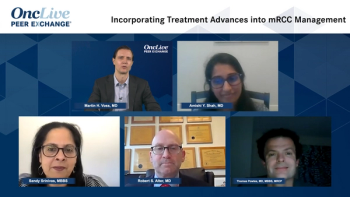
Expectations regarding the impact of research in metastatic renal cell carcinoma on the use of immunotherapy and targeted agents in routine clinical practice.
Novel strategies being explored in various stages of clinical trials as potential therapies for relapsed/refractory metastatic renal cell carcinoma.

Hans Hammers, MD, PhD,discusses the safety profile of lenvatinib in combination with pembrolizumab in renal cell carcinoma.

The FDA has approved nivolumab for the adjuvant treatment of patients with urothelial carcinoma who are at high risk of recurrence after undergoing radical resection, irrespective of prior neoadjuvant chemotherapy, nodal involvement or PD-L1 status.

Considerations for how to approach a patient with metastatic renal cell carcinoma previously treated with ipilimumab and nivolumab, followed by nivolumab maintenance.
An overview of treatment options for previously treated metastatic renal cell carcinoma.

The FDA has issued a complete response letter to Sesen Bio regarding its biologics license application for Vicineum for the treatment of patients with Bacillus Calmette-Guérin–unresponsive non–muscle invasive bladder cancer.

Sacituzumab govitecan-hziy, a Trop-2directed antibody-drug conjugate with an SN-38 payload, has carved out a role in the treatment landscape for patients with locally advanced or metastatic urothelial cancer following accelerated approval by the FDA.
The FDA has approved belzutifan for the treatment of adult patients with von Hippel-Lindau disease who require therapy for associated renal cell carcinoma, central nervous system hemangioblastomas, or pancreatic neuroendocrine tumors that do not require immediate surgery.

Neoadjuvant stereotactic radiation followed by radical nephrectomy and thrombectomy is a safe and feasible treatment option for patients with renal cell carcinoma and inferior vena cava tumor thrombus.
The FDA has approved pembrolizumab plus lenvatinib for the frontline treatment of adult patients with advanced renal cell carcinoma.
The FDA has granted priority review to a new supplemental biologics license application for pembrolizumab as an adjuvant treatment in patients with renal cell carcinoma.
A summary of current therapies and ongoing investigations of adjuvant therapy for patients with operable renal cell carcinoma.
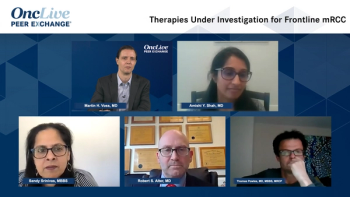
Novel therapies currently being investigated as frontline options for metastatic renal cell carcinoma.

Five-year survival rates in renal cell carcinoma are drastically improving due to recent regulatory approvals of combination therapies involving checkpoint blockade and VEGF TKIs.
Advertisement
Advertisement
Trending on OncLive
1
Savolitinib Plus Osimertinib NDA Submitted to FDA for MET-Driven, EGFR-Mutated NSCLC After EGFR TKI
2
FDA Grants Priority Review to Elinzanetant for Endocrine Therapy–Associated Vasomotor Symptoms in HR+ Breast Cancer
3
Calculating the Real Cost of False Positive Findings in Cancer Screening
4
China's NMPA Approves Pirtobrutinib Across CLL
5