





Genitourinary Cancers
Latest News
Advertisement
Latest Videos

































































Advertisement
More News
Oncologists discuss which patients with advanced RCC might be most suitable for treatment with lenvatinib + pembrolizumab and the appropriate dosing strategies for this regimen.

Moshe Ornstein, MD, MA, discusses the efficacy findings from a phase 2 trial examining neoadjuvant avelumab and axitinib in renal cell carcinoma.

Nektar Therapeutics and Bristol Myers Squibb have announced the decision to end the global clinical development program for the combination of bempegaldesleukin and nivolumab based on findings from preplanned analyses of 2 late-stage clinical trials.

Experts review a clinical scenario of non–clear cell renal cell carcinoma, wherein the patient is managed with cabozantinib-nivolumab.
A brief discussion on the genetic risk tied to clear cell renal cell carcinoma and how that may inform familial risk and testing.
Moshe Ornstein, MD, MA, discusses the benefit of neoadjuvant therapy in renal cell carcinoma.
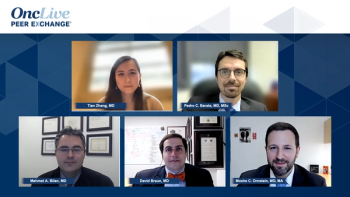
Dr Ornstein weighs in on interpreting quality of life data from important RCC trials to help with treatment decision-making.
Dr Braun explains how biomarkers help to stratify treatment decision-making for patients with RCC.
Expert perspectives on the possible roles of neoadjuvant nivolumab and adjuvant sunitinib for patients with renal cell carcinoma.
A clinical scenario of renal cell carcinoma treated with surgery and adjuvant pembrolizumab is reviewed by a panel of experts.
Drs Barata and Ornstein describe how they treat certain subgroups of patients with advanced RCC, particularly those with brain or bone metastases.
7.Dr Ornstein explains how he selects between IO-TKI and IO-IO therapy in the first-line setting in advanced RCC.

A review of the first-line IO/TKI combination regimens available for advanced RCC and the factors considered in choosing an appropriate treatment.
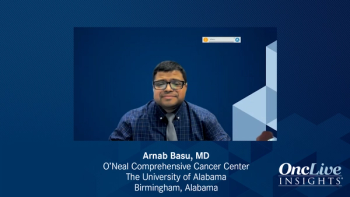
Arnab Basu, MD, presents the patient profile of a 58-year-old woman with advanced renal cell carcinoma presenting with gross hematuria.

Ulka Nitin Vaishampayan, MBBS, discusses the intent of the phase 3 PROBE trial in advanced renal cell carcinoma.
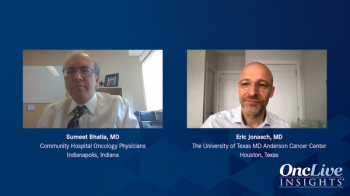
Drs Sumeet Bhatia and Eric Jonasch highlight unmet needs in advanced renal cell carcinoma and share clinical pearls.
Expert perspectives on lenvatinib/pembrolizumab combination therapy in renal cell carcinoma, including appropriate dosing and adverse event management.
Shared insight on the patient and disease factors that inform the selection of therapy for favorable-risk renal cell carcinoma.
Dr Bilen discusses factors to consider when choosing a first-line therapy for advanced clear-cell RCC
David Braun, MD, delves into data from the CheckMate 214 trial that focused on ipilimumab with nivolumab.
Dr Sumeet Bhatia highlights the challenges faced by community oncologists who treat patients with advanced renal cell carcinoma and which patients they refer to academic centers.
Two oncologists describe common adverse events seen with IO-IO combination treatment regimens for advanced renal cell carcinoma, and how they interpret quality of life data from the CheckMate 214 trial.
A second clinical scenario focusing on favorable-risk renal cell carcinoma managed with lenvatinib-pembrolizumab therapy.
A brief discussion on triplet therapy being investigated in patients with intermediate- and poor-risk renal cell carcinoma.
Moshe C. Ornstein, MD, MA, explains the results from the CheckMate 9ER trial that studied cabozantinib with nivolumab.
Advertisement
Advertisement
Trending on OncLive
1
Savolitinib Plus Osimertinib NDA Submitted to FDA for MET-Driven, EGFR-Mutated NSCLC After EGFR TKI
2
FDA Grants Priority Review to Elinzanetant for Endocrine Therapy–Associated Vasomotor Symptoms in HR+ Breast Cancer
3
Calculating the Real Cost of False Positive Findings in Cancer Screening
4
China's NMPA Approves Pirtobrutinib Across CLL
5