



Genitourinary Cancers
Latest News
Advertisement
Latest Videos






























































Advertisement
More News
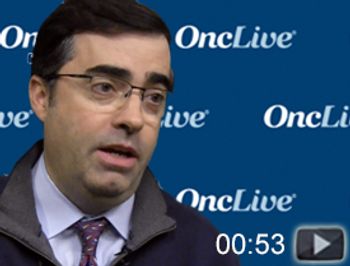
David F. McDermott, MD, director of the Biologic Therapy Program at Beth Israel Deaconess Medical Center, discusses immunotherapy as a standard of care for patients with renal cell carcinoma (RCC).








Sumanta Kumar Pal, MD, co-director of the Kidney Cancer Program at City of Hope, discusses the mutational burden for patients with bladder cancer.
Martin H. Voss, MD, medical oncologist, Memorial Sloan Kettering Cancer Center, discusses the future of the clinical trial space for patients with kidney cancer.
Alicia Morgan, MD, discusses the role of PARP inhibitors as a novel treatment strategy for patients with metastatic castration-resistant prostate cancer.

The FDA has granted the PD-L1 inhibitor avelumab a breakthrough therapy designation for use in combination with the VEGF inhibitor axitinib in treatment-naïve patients with advanced renal cell carcinoma.
Arjun Balar, MD, discusses novel immunotherapy combinations for the treatment of patients with bladder cancer.

The FDA has granted a priority review to a new drug application for apalutamide for the treatment of patients with nonmetastatic castration-resistant prostate cancer.
Andrea B. Apolo, MD, medical oncologist, chief of the bladder cancer section of the Genitourinary Malignancies Branch, National Cancer Institute, discusses challenges with managing toxicities of checkpoint inhibitors for patients with bladder cancer.

Rana R. McKay, MD, assistant professor of medicine and medical oncologist at the University of California, San Diego, discusses the FDA approval of cabozantinib (Cabometyx) in the frontline setting for patients with renal cell carcinoma (RCC).
The FDA has approved cabozantinib for previously untreated patients with advanced renal cell carcinoma.

Tian Zhang, MD, discusses KEYNOTE-564, as well as the progress that immunotherapy has made in the treatment paradigm of patients with RCC.
William K. Oh, MD, chief, Division of Hematology and Medical Oncology, professor of medicine and urology, Mount Sinai School of Medicine, explains when he would choose abiraterone acetate (Zytiga) for patients with prostate cancer.
David F. McDermott, MD, director of the Biologic Therapy Program at Beth Israel Deaconess Medical Center, discusses nivolumab (Opdivo) as a single-agent for the treatment of patients with renal cell carcinoma.
Associated Medical Professionals of New York, a urology and radiation oncology practice, seeks to give its physician partners an equal share of its financial success while rewarding all staff members according to their levels of responsibility and workflow intensity.

The FDA has granted a priority review to a sBLA for use of the combination of nivolumab and ipilimumab as a frontline treatment for intermediate- and poor-risk patients with advanced RCC.

Andrea Apolo, MD, discusses the management of immune-related adverse events in the treatment of bladder cancer.

In results from the North Carolina Prostate Cancer Comparative Effectiveness and Survivorship Study, 52.6% said that preserving sexual function was “very important,” but only 43.4% were assigned to active surveillance.
Advertisement
Advertisement
Trending on OncLive
1
Savolitinib Plus Osimertinib NDA Submitted to FDA for MET-Driven, EGFR-Mutated NSCLC After EGFR TKI
2
FDA Grants Priority Review to Elinzanetant for Endocrine Therapy–Associated Vasomotor Symptoms in HR+ Breast Cancer
3
Calculating the Real Cost of False Positive Findings in Cancer Screening
4
Cilta-Cel Shows Long-Term Treatment-Free Remissions in Lenalidomide-Refractory Myeloma
5