


Lung Cancer
Latest News
Advertisement
Latest Videos






























































Advertisement
More News
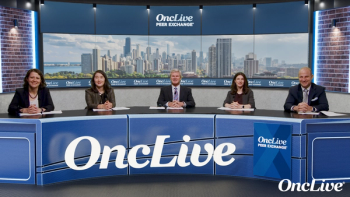
The panel examines the characteristics of patients with non-small cell lung cancer (NSCLC) without actionable alterations who might be the best candidates for frontline treatment with either sacituzumab govitecan or datopotamab deruxtecan (Dato-DXd) and identifies the persisting unmet needs for this patient population.
Frontline osimertinib plus chemotherapy has been approved in the European Union for adult patients with advanced EGFR-mutated non–small cell lung cancer.

First-line tiragolumab plus atezolizumab and chemotherapy failed to improve survival in advanced nonsquamous non–small cell lung cancer.
A medical expert discusses the impact of the 3-year overall survival data from the CASPIAN trial on the treatment landscape for extensive-stage small cell lung cancer (ES-SCLC), emphasizing the significance of the long-term follow-up results in shaping the current treatment paradigm.
Tarita O. Thomas, MD, PhD discusses patients with LS-SCLC, and what she would consider to be a reasonable time interval between completion of cCRT to initiation of consolidation therapy with a PD-L1 inhibitor. The panel also discusses the potential for curative-intent immunotherapy with durvalumab for earlier stages of SCLC.
Salman R. Punekar, MD discusses the rationale for evaluating safety and preliminary anti-tumor activity of NT-112 in solid tumors with the KRAS G12D mutation.
Julia Rotow, MD, explores the rationale, study design, and primary endpoints of the AVANZAR trial, which investigated the combination of datopotamab deruxtecan (Dato-DXd), durvalumab, and carboplatin as a first-line treatment for patients with advanced non-small cell lung cancer lacking actionable mutations, and discusses the patient population most likely to benefit from this drug combination.
Benjamin Levy, MD, presents an overview of the TROPION-Lung04 study in the first-line setting, focusing on the toxicity profile and potential impact on clinical practice.
In case you missed any, below is a recap of every OncLive On Air episode that aired in June 2024.

Taofeek Owonikoko, MD, PhD, expands on the FDA approval of tarlatamab for patients with extensive-stage small cell lung cancer.

Suresh S. Ramalingam, MD, FACP, FASCO, and Chandler H. Park, MD, FACP, discuss updates in non–small cell lung cancer at the 2024 ASCO Annual Meeting.
The FDA has issued a complete response letter to the BLA for patritumab deruxtecan in pretreated advanced EGFR-mutated non–small cell lung cancer.
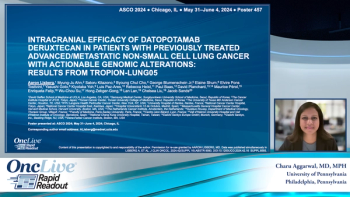
Tropion-Lung05 (NCT04484142) is a phase 2, multicenter, single-arm, open-label study evaluating Dato-DXd in patients with advanced/metastatic NSCLC with actionable genomic alterations who have progressed on or after targeted therapy and platinum-based CT.
Osimertinib received approval in China in combination with pemetrexed and platinum-based chemotherapy for patients with advanced EGFR-mutant NSCLC.
Panel experts analyze findings from the phase 3 ADRIATIC trial, examining overall and progression-free survival data, exploring the interaction between durvalumab and concurrent chemoradiotherapy within the tumor microenvironment, and evaluating the impact of time intervals from the completion of concurrent chemoradiotherapy to the initiation of consolidation therapy with a PD-L1 inhibitor.
Medical experts in small cell lung cancer convene to examine first-line treatments, ongoing clinical trials, and emerging therapies shaping the evolving treatment landscape.
John Heymach, MD, PhD, discusses perioperative durvalumab in patients with resectable non-small cell lung cancer.

The Japanese PMDA has approved first-line osimertinib plus chemotherapy for EGFR-mutated advanced non–small cell lung cancer.

Adjuvant durvalumab did not improve disease-free survival in resected, early-stage non–small cell lung cancer with a PD-L1 expression 25% or more.
Jorge J. Nieva, MD, details the role of telemedicine for patients with non–small cell lung cancer and a first-of-its-kind study examining atezolizumab given subcutaneously at home.
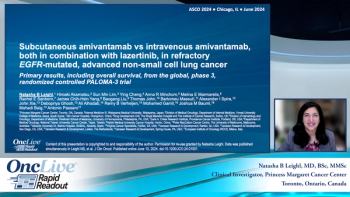
Dr. Natasha Leighl presents the primary results of the phase 3, randomized controlled PALOMA-3 (NCT05388669) trial assessing the overall survival and non-inferiority of subcutaneous amivantamab compared to intravenous amivantamab, in combination with lazertinib, in patients with refractory EGFR-mutated, advanced non-small cell lung cancer.
Benjamin Levy, MD, leads discussion on the promising potential of antibody-drug conjugates (ADCs) in treating non-small cell lung cancer (NSCLC) with non-actionable mutations, while Helena A. Yu, MD, presents an overview of the EVOKE-02 study, emphasizing key efficacy and safety data that could significantly impact the current treatment landscape.
Mark Socinski, MD; Helena A. Yu, MD; Zosia Piotrowska, MD, MHS; Julia Rotow, MD; and Benjamin Levy, MD, provide a concise overview of current first-line treatment options for non-small cell lung cancer (NSCLC), including their approaches for NSCLC with non-actionable mutations and the influence of PD-L1 tumor proportion score status on treatment choices.
A panel of expert clinicians discuss the treatment landscape of HER2-mutant non–small cell lung cancer, highlighting the current roles of ADCs and TKIs, and unmet needs that remain in the space.

Sid Devarakonda, MD, details the role of surgery for patients with non–small cell lung cancer and approaches for treating patients with metastatic disease.
Advertisement
Advertisement
Trending on OncLive
1
FDA Approves Tucatinib Plus Trastuzumab/Pertuzumab as First-Line Maintenance in Advanced HER2+ Breast Cancer
2
Iberdomide Plus Daratumumab/Dexamethasone Yields Significant PFS Benefit in R/R Myeloma
3
FDA Approves Atezolizumab Plus Chemo for Stage III dMMR Colon Cancer
4
VIR-5500 Receives FDA Fast Track Designation in mCRPC
5