





Lung Cancer
Latest News
Advertisement
Latest Videos
































































Advertisement
More News

Pasi A. Jänne, MD, PhD discusses the FDA approval of osimertinib plus chemotherapy for patients with EGFR-positive non–small cell lung cancer.

The FDA has granted breakthrough therapy designation to NVL-520 for pretreated, metastatic ROS1-positive non–small cell lung cancer.

In case you missed it, read a recap of every episode of OncLive On Air recorded in January 2024.
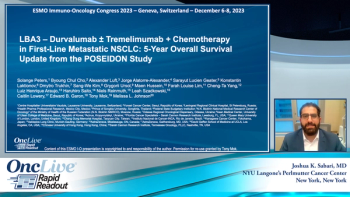
Joshua K. Sabari, MD, reviews data from the 5-year overall survival update from the POSEIDON study investigating durvalumab, tremelimumab, and chemotherapy in first-line metastatic non–small cell lung cancer.

The European Medicines Agency’s CHMP has recommended the approval of tislelizumab in the first- and second-line for non–small cell lung cancer.
BAY 2927088 has received breakthrough therapy designation by the FDA for pretreated non–small cell lung cancer harboring activating HER2 mutations.

Pembrolizumab plus chemotherapy followed by adjuvant pembrolizumab has been recommended for approval in high-risk NSCLC by the EMA's CHMP.

Chul Kim, MD, MPH, discusses the impact of optimizing rare targets in lung cancer, highlighting the FDA approval of repotrectinib in ROS1-positive disease.

Salman R. Punekar, MD, discusses the importance of complete biomarker testing and the landscape of biomarkers in lung cancer.

Federico Cappuzzo, MD, discusses findings from the phase 3 RATIONALE-315 trial in patients with resectable non–small cell lung cancer.

Lurbinectedin demonstrated greater activity and a superior safety profile vs topotecan in a subset of small cell lung cancer.

Neoadjuvant tislelizumab plus platinum-based doublet chemotherapy followed by surgery and adjuvant tislelizumab demonstrated efficacy in resectable non–small cell lung cancer.

The European Medicines Agency has granted orphan drug designation to UV1 in patients with mesothelioma.
A BLA seeking the approval of datopotamab deruxtecan in pretreated nonsquamous non–small cell lung cancer is under review by the FDA.

Following chemoradiation, maintenance osimertinib improved PFS vs placebo in patients with stage III EGFR-mutant non–small cell lung cancer.

Jobelle Baldonado, MD, highlights the emergence of targeted therapies and the need for reflex-ordered molecular testing in early-stage lung cancer.

Pasi A. Jänne, MD, PhD, discusses the FDA approval of osimertinib plus chemotherapy in patients with EGFR-mutant locally advanced or metastatic NSCLC.
The FDA has approved osimertinib (Tagrisso) plus chemotherapy for use in patients with locally advanced or metastatic non–small cell lung cancer harboring EGFR mutations.
The FDA has granted approval to tepotinib (Tepmetko) for adult patients with metastatic non–small cell lung cancer harboring MET exon 14 skipping alterations.

Joshua K. Sabari, MD, discusses updates in ADCs in NSCLC.

Joshua K. Sabari, MD, explains the utility of ADCs in patients with NSCLC and their benefit in patients with EGFR-, ALK-, or HER2-mutant disease.
Repotrectinib is under priority review for patients with NTRK-positive locally advanced or metastatic solid tumors and high unmet medical need.

Edgardo S. Santos Castillero, MD, FACP, discusses current unmet needs that remain to be addressed in patients with relapsed/refractory non–small cell lung cancer.

Dr. Shirish Gadgeel discusses the activity of antibody drug conjugates against brain metastases in non-small cell lung cancer based on emerging data, suggesting superiority over chemotherapy.

Joshua K. Sabari, MD, discusses the investigation of patritumab deruxtecan in EGFR-mutant non–small cell lung cancer.
Advertisement
Advertisement
Trending on OncLive
1
FDA Approves Tucatinib Plus Trastuzumab/Pertuzumab as First-Line Maintenance in Advanced HER2+ Breast Cancer
2
FDA Grants Breakthrough Device Designation to Natera’s Multi-Cancer Early Detection Assay
3
VIR-5500 Receives FDA Fast Track Designation in mCRPC
4
FDA Approves Atezolizumab Plus Chemo for Stage III dMMR Colon Cancer
5