Luis E. Raez, MD, discusses how oral TKIs may shift frontline sequencing across ROS1-positive, HER2-mutant, and EGFR exon 20 insertion–positive NSCLC.
Luis E. Raez, MD, discusses how oral TKIs may shift frontline sequencing across ROS1-positive, HER2-mutant, and EGFR exon 20 insertion–positive NSCLC.
Luis E. Raez, MD, discusses molecular testing, screening gaps, and global drug access challenges in lung cancer across Latin America and the US.
Dr. Weinberg envisions increasing ctDNA incorporation into adjuvant decision-making, anticipating that Circulate North America results will provide comfort for de-escalating ctDNA-negative patients while escalating ctDNA-positive patients.
Dr. Raez addresses choosing between tumor-informed and tumor-naïve platforms, noting no formal prospective comparison exists.
Dr. Weinberg addresses where evidence is strongest versus where the field risks getting ahead of itself.
Dr. Teplinsky, reflecting on commonalities across tumor types, notes that although the discussion focused on early-stage breast cancer, increasing ctDNA use exists in metastatic disease to identify treatment-emergent mutations guiding therapy selection, representing a different application context.
Dr. Raez discusses IASLC 2025 data, now published in the Journal of Thoracic Oncology, representing important progress for lung cancer's MRD research, which has historically lagged behind gastrointestinal and genitourinary cancers.
Dr. Weinberg addresses practical workflows for ctDNA-positive, imaging-negative patients, noting no current standard of care exists despite NCCN guidelines addressing elevated CEA management.
Dr. Weinberg discusses 2 major observational datasets informing colorectal cancer ctDNA practice.
Dr. Teplinsky discusses the evolving breast cancer surveillance paradigm, noting historical data showing routine imaging surveillance doesn't impact outcomes, though this data predates modern imaging technology.
Dr. Grivas confirms ctDNA integration into multidisciplinary tumor boards is increasing, describing his bladder cancer multidisciplinary clinic involving urology, medical oncology, radiation oncology, and pathology/radiology review focused on localized muscle-invasive bladder cancer.
Dr. Weinberg explains the treatment on molecular recurrence (TOMR) concept, drawing parallels to biochemical relapse monitoring in prostate cancer. In colorectal cancer, patients with positive ctDNA after completing curative-intent surgery and adjuvant chemotherapy will experience radiographic recurrence at a median of approximately 5.5 months, representing a population potentially amenable to curative intervention through escalated imaging to identify oligometastatic disease suitable for metastasectomy, or enrollment in novel drug development trials.
Dr. Teplinsky addresses where ctDNA and MRD testing fit within the patient care continuum, noting that value isn't uniform across disease stages or tumor types. The strongest signal currently exists in the post-treatment surveillance setting, where tumor-informed assays can identify patients at higher recurrence risk before disease becomes visible on imaging.
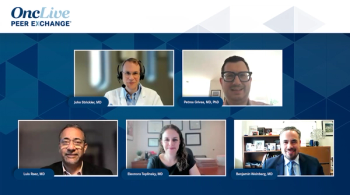
Dr. John Strickler introduces the program on circulating tumor DNA (ctDNA) and minimal residual disease (MRD) testing across solid tumors, joined by Dr. Eleonora Teplinsky (breast and gynecologic oncology, Valley Health System), Dr. Ben Weinberg (gastrointestinal oncology, Georgetown University), Dr. Petros Grivas (genitourinary oncology, Fred Hutchinson Cancer Center), and Dr. Luis Raez (thoracic oncology, Memorial Healthcare System).

Luis E. Raez, MD, FACP, FCCP, discusses the significance of the FDA approval of repotrectinib in solid tumors harboring an NTRK gene fusion.
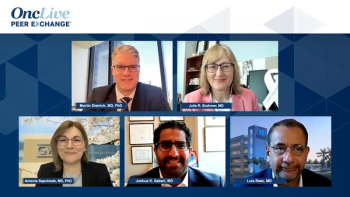
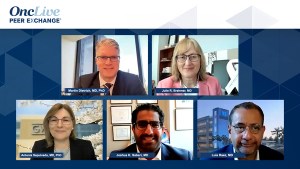
Closing out their discussion on biomarker testing and targeted therapies in non–small cell lung cancer, the panel of expert oncologists share clinical pearls and thoughts on the evolving treatment landscape.
Julie R. Brahmer, MD, details emerging targets in non–small cell lung cancer and the outlook for the future of treatment.
The focus turns to therapeutic strategies for treating MET exon 14 non–small cell lung cancer.
Experts on non–small cell lung cancer share their approaches to treating patients who have RET fusions and review updates on selpercatinib and pralsetinib.
Julie R. Brahmer, MD, and Joshua K. Sabari, MD, review recent data on entrectinib and larotrectinib for the treatment of patients with NSCLC with NTRK fusions.
The expert panel discusses factors that influence treatment decisions when choosing appropriate therapy for patients with ALK-rearranged NSCLC.
Experts on non–small cell lung cancer discuss recent data on brigatinib and lorlatinib for the treatment of patients with ALK rearrangements.
Luis Raez, MD, offers insights on how co-mutations in STK11 or KEAP1 impact the use of immunotherapies in KRAS G12C–mutant non–small cell lung cancer.
Joshua K. Sabari, MD, discusses adagrasib as a treatment of patients with NSCLC with KRAS G12C mutations, and provides insight on treating patients who have progressed on prior KRAS G12C inhibitors.
Expert panelists review the CodeBreaK trials focused on sotorasib in the treatment of patients with KRAS G12C-mutant non–small cell lung cancer.
Shared insight on the use of first-generation EGFR tyrosine kinase inhibitors and the role of immunotherapy in treating patients with NSCLC with uncommon EGFR mutations.
Julie R. Brahmer, MD, discusses treatment considerations when choosing between afatinib and osimertinib in patients with NSCLC with rare EGFR mutations.
Key opinion leaders on non–small cell lung cancer review treatment options for patients with EGFR mutations.
Experts on non–small cell lung cancer discuss strategies to improve molecular testing and opportunities for community physicians to reach out to expert oncologists for clinical insights.
Antonia Sepulveda, MD, PhD, an expert on NSCLC, outlines discrepancies in molecular testing between academic and community settings.
September 19th 2023
September 12th 2023
October 3rd 2023