



Ovarian Cancer
Latest News
Advertisement
Latest Videos

































































Advertisement
More News

Floor J. Backes, MD, discusses the role of PARP inhibitors as treatment of patients with ovarian cancer and her experience with these agents, such as rucaparib.

Angeles Alvarez Secord, MD, discusses a presentation from the 2020 SGO Winter Meeting that focused on assistance with the financial burden associated with PARP inhibitors in patients with ovarian cancer.
Three pivotal clinical trials evaluating PARP inhibitors have significantly impacted the treatment of patients with newly diagnosed ovarian cancer.

Julia Fehniger, MD, shares her thoughts on the development of PARP inhibitors in ovarian cancer and expansion into other tumor types.

Angeles Alvarez Secord, MD, gynecologic oncologist, Duke Cancer Center, discusses the role of PARP inhibitors in ovarian cancer based on their current indications in the treatment landscape.

Floor J. Backes, MD, discusses the latest advancements made in the treatment of patients with ovarian cancer and the ongoing research efforts that are being made with novel combinations.

In ovarian cancer, disease that returns within 6 months of treatment following platinum-based therapy is defined as platinum-sensitive.

Linda R. Duska, MD, discusses primary debulking surgery in ovarian cancer.
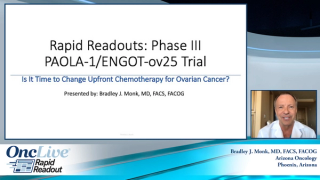
Maintenance treatment with PARP inhibitors should be the standard of care in the frontline setting for patients with ovarian cancer, Kathleen M. Moore, MD, said during a presentation at the 2020 Society of Gynecologic Oncology Winter Meeting.

Antonio González-Martín, MD, discusses the design and findings of the PRIMA trial in advanced ovarian cancer.
Robert L. Coleman, MD, FACOG, FACS, discusses the VELIA trial and the impact the results are going to have on the use of PARP inhibitors in ovarian cancer.

The National Institute for Health and Care Excellence has recommended the use of olaparib as a maintenance treatment in adults with relapsed, platinum-sensitive, high-grade epithelial ovarian, fallopian tube, or primary peritoneal cancer.
PARP inhibitors are poised to acquire a stronger foothold in the frontline setting for advanced ovarian cancer, for which chemotherapy remains the backbone of treatment, according to a panel of gynecologic oncology experts who discussed the issue during an OncLive Peer Exchange® held during the European Society for Medical Oncology Congress 2019.

The FDA has granted a priority review designation to a supplemental new drug application for the combination of olaparib and bevacizumab for the maintenance treatment of patients with advanced ovarian cancer who are in complete or partial response to first-line platinum-based chemotherapy with bevacizumab.

Jessica Layne Berger, MD, discusses the frontline treatment options in newly diagnosed ovarian cancer.



Advertisement
Advertisement
Trending on OncLive
1
Dr Cercek on the FDA Approval of Dostarlimab for dMMR/MSI-H Locally Advanced Rectal Cancer
2
Weigh Benefit Against Burden: Defining Lurbinectedin’s Role in a Shifting Small Cell Lung Cancer Landscape
3
Vilamakitug Meets OS Threshold in Phase 1/2 Refractory mCRC Trial
4
Dr Warren on the Goal of the 4WARD Trial Evaluating Mavorixafor in Chronic Neutropenia
5