

Sarcomas
Latest News


Randall Spotlights Surgical and Non-Surgical Advances in Musculoskeletal Oncology
Addition of Doxorubicin to Zalifrelimab/Balstilimab Leads to Responses in Advanced Soft Tissue Sarcoma
By Ryan Scott
Advertisement
Latest Videos
































































Advertisement
More News

The PD-1 inhibitor pembrolizumab displayed activity with a manageable safety profile in patients with certain rare and ultra-raresarcoma histotypes.
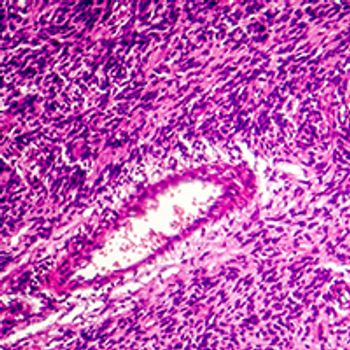
Treatment with camsirubicin led to a reduction in tumor size in patients with advanced soft tissue sarcoma.

The FDA has approved the therascreen PDGFRA RGQ PCR kit for use as a companion diagnostic, co-developed by Qiagen and Blueprint Medicines, to assist in the identification of patients with gastrointestinal stromal tumors who may be candidates to receive avapritinib.
R. Lor Randall, MD, FACS, provides details about the 2024 Birmingham Orthopedic Oncology Meeting and its main topic of discussion, explains the rationale for its inception, and emphasizes the importance of this meeting for orthopedic oncologists treating chondrosarcoma.
Jonathan C. Trent, MD, PhD, discusses data from 2 phase 2 trials of immunotherapy in soft tissue sarcoma, as well as their clinical significance.

Theseus Pharmaceuticals has announced that the development of THE-630 as a potential therapeutic option for patients with gastrointestinal stromal tumor has been terminated, and enrollment to the ongoing phase 1/2 trial evaluating the agent’s safety and efficacy in this population has been discontinued.

Andrew S. Brohl, MD, discusses the safety and immunologic responses with intratumoral administration of Idx-Hu2.0 in patients with advanced Merkel cell carcinoma and cutaneous squamous cell carcinoma.

Breelyn A. Wilky, MD, discusses the rationale for investigating the combination of zalifrelimab, balstilimab, and doxorubicin in patients with advanced/metastatic soft tissue sarcoma, and early results from a phase 2 trial.

Damon R. Reed, MD, discusses a phase 2 study of fam-trastuzumab deruxtecan-nxki in adolescent and young adult patients with recurrent HER2-positive osteosarcoma.
R. Lor Randall, MD, FACS, discusses the use of neoadjuvant pazopanib in patients with non-rhabdomyosarcoma soft tissue sarcoma, expanded on findings from the subgroup analysis of ARST1321, and detailed the implications of these findings.

R. Lor Randall, MD, FACS, discusses findings from a study of one-stage synovectomy in patients with diffuse-type tenosynovial giant cell tumor of the knee.
R. Lor Randall, MD, FACS, discusses the standard treatment approach for patients with diffuse-type tenosynovial giant cell tumor, the results of the retrospective cohort study evaluating 1- vs 2-stage synovectomies in these patients, and the importance of having additional treatment options for this patient population.
A full dose of lurbinectedin plus a low dose of doxorubicin was clinically active and tolerable in patients with advanced or metastatic soft tissue sarcomas, supporting its continued investigation in those with leiomyosarcoma.

The FDA has extended the Prescription Drug User Fee Act decision date by 3 months to allow more time to complete their review of the new drug application seeking the approval of nirogacestat in the treatment of adult patients with desmoid tumors.

Treatment with doxorubicin plus zalifrelimab and balstilimab produced a favorable 6-month progression-free survival rate in patients with difficult-to-treat soft tissue sarcoma subtypes unlikely to respond to doxorubicin or immune checkpoint inhibitor monotherapy.
Treatment with the investigational gamma secretase inhibitor nirogacestat allowed patients with progressing desmoid tumors to experience a significant and clinically meaningful reduction in several aspects of disease-related pain when compared with placebo.

The China National Medical Products Adminstration’s Center for Drug Evaluation has recommended that olverembatinib receive breakthrough therapy designation for the treatment of patients with gastrointestinal stromal tumor that is succinate dehydrogenase deficient.
Treatment with milademetan did not lead to a statistically significant improvement in progression-free survival compared with trabectedin in patients with dedifferentiated liposarcoma, failing to reach the primary end point of the phase 3 MANTRA trial.
The FDA has placed a partial clinical hold on the phase 1 trial evaluating the safety, tolerability, pharmacokinetics, pharmacodynamics, and early clinical activity of FHD-609 in patients with advanced synovial sarcoma and SMARCB1-deleted tumors.

The combination of PARP and ATR inhibition with olaparib and ceralasertib was tolerable but showed limited efficacy in pediatric patients with advanced malignancies harboring DNA replication stress and DNA repair deficiencies, according to findings from arm N of the phase 1/2 AcSé-ESMART trial.
Thrombocytopenia is a common adverse effect associated with treatment with the MDM2 inhibitor milademetan in patients with sarcomas and other solid tumors, and the effects of thrombocytopenia can be mitigated with an intermittent dosing schedule and managed with dose interruptions or reductions.
The FDA has granted an orphan drug designation to TP-1287, an investigational oral CDK9 inhibitor, for the treatment of patients with Ewing sarcoma.
The oral MDM2/p53 antagonist BI 907828 elicited preliminary antitumor activity and had a manageable safety profile in patients with MDM2-amplified dedifferentiated liposarcoma.
R. Lor Randall, MD, FACS, expands on data from a phase 3 trial evaluating the addition of ganitumab to standard-of-care, interval-compressed chemotherapy, the implications of these results, and how the study could help inform future trials exploring other targeted therapies for the treatment of patients with metastatic Ewing sarcoma.
R. Lor Randall, MD, FACS, discusses the presentation and diagnosis of mesenchymal chondrosarcomas, the role of HEY1-NCoA2 gene fusions in the disease, and potential treatment options for this rare subgroup of patients.
Advertisement
Advertisement
Trending on OncLive
1
FDA Approves Nogapendekin Alfa Inbakicept Plus BCG for High-Grade, Papillary-Only BCG-Unresponsive NMIBC
2
SurVaxM Cancer Vaccine Shows Clinically Meaningful OS Signal in Newly Diagnosed Glioblastoma
3
VS-7375 Elicits Responses in KRAS G12D–Mutated Pancreatic Cancer
4
FDA Accepts BLA Resubmission for Tabelecleucel in EBV+ Post-Transplant Lymphoproliferative Disease
5