
Ajai Chari, MD, discusses how the FDA approval of talquetamab addresses several unmet needs in relapsed/refractory multiple myeloma and expands on the agent’s efficacy data and safety profile observed in MonumenTAL-1.
Ajai Chari, MD, discusses how the FDA approval of talquetamab addresses several unmet needs in relapsed/refractory multiple myeloma and expands on the agent’s efficacy data and safety profile observed in MonumenTAL-1.
Ajai Chari, MD, discusses the significance of the FDA approval of talquetamab in patients with relapsed/refractory multiple myeloma.
Collin Blakely, MD, PhD, discusses a phase 2 trial evaluating the use of neoadjuvant osimertinib in patients with surgically resectable EGFR-mutated non-small cell lung cancer, findings from which were presented at the 2023 ASCO Annual Meeting.
Denise M. Wolf, PhD, discusses research into biomarkers predicting responses to immunotherapy in the phase 2 I-SPY2 trial in patients with early-stage breast cancer.
Ana I. Velazquez Manana, MD, MSc, discusses how systemic racism appears in oncology.

Responses achieved with enfortumab vedotin plus pembrolizumab were found to be rapid and durable in patients with previously untreated locally advanced or metastatic urothelial carcinoma who were cisplatin ineligible.
Dr Manana discusses how systemic racism appears in oncology practice, tools clinicians can use to learn about and address their implicit biases, and the importance of connecting patients with a multidisciplinary team to provide necessary resources and care.

The addition of gedatolisib to palbociclib and letrozole produced durable responses with comparable safety to that observed with palbociclib and letrozole alone in treatment-naïve patients with estrogen receptor-positive, HER2-negative advanced breast cancer.
R. Kate Kelley, MD, details the ongoing investigation of RLY-4008 for patients with advanced cholangiocarcinoma harboring FGFR2 fusions or rearrangements, other ongoing investigations in cholangiocarcinoma, and the importance of molecular testing to drive treatment decisions in this population.
Sohail Dhanji, MD, discusses the investigation of preoperative hypertension as a risk factor in patients undergoing nephroureterectomy for upper tract urothelial carcinoma, as well as other risk factors for mortality in this patient population.

Patient-reported outcomes with fam-trastuzumab deruxtecan-nxki in HER2-positive metastatic breast cancer reflected the regimen’s favorable risk-benefit profile in the phase 3 DESTINY-Breast02 trial, according to findings presented during the 2023 ESMO Breast Cancer Annual Congress.
Treatment with trastuzumab deruxtecan resulted in lower exposure-adjusted incidence rates per patient-year of treatment-emergent adverse effects compared with treatment of physician’s choice in patients with HER2-low unresectable and/or metastatic breast cancer, according to safety analysis from the phase 3 DESTINY-Breast04 trial.
Rahul Aggarwal, MD, discusses key findings from a phase 2a trial evaluating the combination of BXCL701 and pembrolizumab in patients with metastatic castration-resistant prostate cancer with the small cell neuroendocrine cancer phenotype.
Dr Friedlander discusses the FDA approval of enfortumab vedotin plus pembrolizumab in patients with locally advanced or metastatic urothelial carcinoma, key efficacy and safety data from the EV-103 trial, and the importance of incorporating this regimen into the frontline setting for this population.
Terence Friedlander, MD, discusses the significance of the FDA approval of enfortumab vedotin combined with pembrolizumab for patients with locally advanced or metastatic urothelial carcinoma, and expands on the data from the EV-103/KEYNOTE-869 trial that supported the approval.
The combination of BXCL701 and pembrolizumab produced durable responses in patients with platinum-resistant small cell neuroendocrine carcinoma metastatic castration-resistant prostate cancer, according to data from a phase 2a trial presented at the 2023 Genitourinary Cancers Symposium.
Terence Friedlander, MD, discusses the significance of the FDA approval of frontline enfortumab vedotin combined with pembrolizumab in patients with urothelial carcinoma.
Laura J. Esserman, MD, MBA, discusses the effect early end points could have for clinical trials in breast cancer, how these end points could help usher in more individually tailored treatment options based on an individual patient’s disease and response, and how early end points have been used in the ongoing phase 2 I-SPY 2 trial.
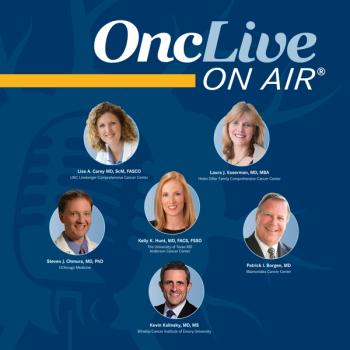
Faculty from the 40th Annual Miami Breast Cancer Conference® feature updates in the treatment of patients across the breast cancer continuum.
As more antibody-drug conjugates emerge and investigators foresee fam-trastuzumab deruxtecan-nxki moving forward in lines of treatment for metastatic disease, the treatment landscape of hormone receptor–positive, HER2-negative breast cancer continues to expand and shift.
Laura J. Esserman, MD, MBA, discusses the rationale and design for the phase 2 I-SPY2 trial.
Closing out their discussion on TIL therapy, Drs Sarnaik and Komanduri identify existing barriers to TIL use in clinical practice and how the field might optimize patient access to these regimens.
Experts Amod Sarnaik, MD, and Krishna Komanduri, MD, consider lessons learned about TILs and CAR T-cell therapy in hematologic cancers, and how they anticipate TILs fitting into treatment paradigms for solid tumors.
Shared insight from Amod Sarnaik, MD, and Krishna Komanduri, MD, on the halted DELTA-1 clinical trial of ITIL-168 in melanoma, followed by a focused discussion of SITC 2022 data on emerging TIL design and manufacturing strategies.
Expert perspectives on results from C-144-01, which utilized the TIL therapy lifileucel in the setting of metastatic melanoma, and situations in which the regimen might be used in clinical practice.
A focused discussion on clinical trial data presented at SITC 2022 elucidating the biologic activity of tumor-infiltrating lymphocyte therapies.
Shared insight on the benefits and drawbacks of using tumor-infiltrating lymphocyte therapy for treatment of solid tumors, as compared to chimeric antigen receptor (CAR) T-cell therapy.
Expert perspectives on the mechanism of action behind tumor-infiltrating lymphocyte (TIL) therapy and how it might address existing unmet needs in the treatment of solid tumors, including melanoma and non–small cell lung cancer.

An unshakeable belief in the power of the immune system and a deep-seated desire to make the world a better place have guided Eric J. Small, MD, throughout his career.
Dr Rugo discusses overall survival in the TROPiCS-02 trial, post-progression treatments after ribociclib and endocrine therapy in the MONALEESA-2, MONALEESA-3, and MONALEESA-7 studies, and what the AMALEE trial indicates about optimal doses of ribociclib in hormone receptor–positive breast cancer.