





Gastrointestinal Cancer
Latest News
Advertisement
Latest Videos





















































Advertisement
More News
The FDA has approved irinotecan liposome (Onivyde) with oxaliplatin, fluorouracil, and leucovorin, for the frontline treatment of metastatic pancreatic adenocarcinoma.
AlphaMedix has received breakthrough therapy designation from the FDA for use in select patients with gastroenteropancreatic neuroendocrine tumors.

Experts share preventative and management strategies for nail toxicities and mouth sores that can cause significant quality of life issues for patients being treated with FGFRi.
Hyperphosphatemia is the most common AE associated with FGFRi treatments and can impact patient quality of life, but there are treatments and possible diet changes that may help mitigate this AE.

Fruquintinib/paclitaxel significantly improved PFS but not OS vs paclitaxel alone in the second-line treatment in patients with advanced gastric cancer.
Efineptakin alfa received an orphan drug designation from the FDA for use as a potential therapeutic option in patients with pancreatic cancer.
John Michael Bryant, MD, discusses the effects of germline DNA repair mutations on radiosensitivity in patients with pancreatic ductal adenocarcinoma.
The FDA has granted a fast track designation to the T-cell therapy BST02 for the treatment of patients with all forms of liver cancer.

Kohei Shitara, MD, discusses 4-year survival data of chemotherapy plus nivolumab in advanced gastric/GEJ cancer or esophageal adenocarcinoma.
Ocular toxicities from dry eye to development of cataracts are potential risks with FGFRi treatment; providers share management strategies.

A patient with cholangiocarcinoma shares her experience while being treated with an FGFR inhibitor, as well as insights on what providers should tell their patients to help them best manage or possibly prevent these adverse events.
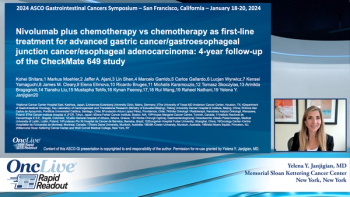
Yelena Y. Janjigian, MD, presents 4-year follow-up data from the CheckMate 649 study investigating frontline nivolumab plus chemotherapy in patients with advanced gastric cancer/gastroesophageal junction cancer/esophageal adenocarcinoma.

Ilyas Sahin, MD, discusses an assessment of the Northstar Response in patients with advanced gastrointestinal cancer undergoing active treatment.
A review of how frequently adverse events from hyperphosphatemia to nail toxicities to stomatitis and more.
Provider perspectives on the importance of education patients about potential adverse events they may experience when initiating treatment with FGFR inhibitors.

Laleh Melstrom, MD, MS, discusses using molecular testing to guide treatment selection for patient with gastrointestinal cancers.

Minimal residual disease detection by ctDNA was predictive and prognostic of disease recurrence and response to adjuvant chemotherapy in patients with CRC.

Favorable ECOG PS, lower LDH levels, and absence of BRAF and KRAS mutations at baseline were associated with long-term response to regorafenib in patients with mCRC in the real world.

Larotrectinib led to long-lasting responses, encouraging survival, and a favorable safety profile in TRK fusion-positive gastrointestinal cancers.

Lutetium Lu 177 dotatate plus octreotide significantly improved PFS vs high-dose octreotide in patients with gastroenteropancreatic neuroendocrine tumors.
PFS was significantly improved with durvalumab plus bevacizumab and TACE vs TACE alone in patients with unresectable HCC eligible for embolization.

The use of FOLFOXIRI plus bevacizumab increased in patients with metastatic colorectal cancer from 2013 to 2022, especially in patients 50 years of age or younger.

Kohei Shitara, MD, discusses first-line nivolumab plus chemotherapy vs chemotherapy alone in gastric cancer, GEJ cancer, or esophageal adenocarcinoma.

Fostroxacitabine bralpamide plus lenvatinib displayed preliminary efficacy with a tolerable safety profile in patients with hepatocellular carcinoma.

Pembrolizumab plus lenvatinib produced survival outcomes that were consistent with previous findings from the phase 3 LEAP-002 trial along with an extended duration of response.
Advertisement
Advertisement
Trending on OncLive
1
INBRX-106 Plus Pembrolizumab Improves Responses and PFS in First-Line PD-L1–Positive HNSCC
2
FDA Approves Pirtobrutinib for Previously Untreated CLL/SLL
3
Epcoritamab Plus R-CHOP Meets PFS End Point in Newly Diagnosed DLBCL
4
‘Our Impact Will Be Broad and Transformative’: Wells Messersmith, MD, Takes the Reins at CU Anschutz Cancer Center
5