






Lung Cancer
Latest News
Advertisement
Latest Videos





































































Advertisement
More News

Lung cancer experts share updates in the treatment of ALK-mutant NSCLC and KRAS G12C–mutant NSCLC as seen in the CROWN study, BrigALK2 real-world study, and CODEBreaK 100 study.
Heather Wakelee, MD, reviews key data for the treatment of MET exon 14 mutations in NSCLC as seen in the GeoMETry-III trial and the CRYSALIS study.
Experts briefly review a number of other agents in NSCLC that target EGFR exon 20 insertion mutations.

Shared insight on the differences between amivantamab and mobocertinib and when they may be appropriately used in patients with NSCLC.

Diane Reidy-Lagunes, MD, discusses the results of the phase 3 SPINET trial by tumor subtype in bronchopulmonary neuroendocrine tumors.

Edgardo Santos, MD, discusses the current state of targeted therapies for EGFR- and ALK-positive non–small cell lung cancer, as well as immunotherapy in stage III NSCLC, and management strategies in small cell lung cancer.

Corey J. Langer, MD, professor of medicine, University of Pennsylvania, director, Thoracic Oncology, Penn Medicine, discusses the evolution of molecular testing in advanced non–small cell lung cancer.

Xiuning Le, MD, PhD, discusses the emergence of antibody-drug conjugates in non–small cell lung cancer.

Sandip P. Patel, MD, discusses novel targets in non–small cell lung cancer.

T-cell inflamed gene expression profile and tumor mutational burden assessment was found to be a feasible approach to study the clinical activity of 3 pembrolizumab-based combination regimens in treatment-naïve patients with advanced non–small cell lung cancer.

The European Medicines Agency’s Committee for Medicinal Products for Human Use has adopted a positive opinion recommending the conditional marketing authorization of sotorasib for the treatment of adult patients with advanced non–small cell lung cancer whose tumors harbor a KRAS G12C mutation and who have progressed after at least 1 prior line of systemic therapy.
Dr Vamsidhar Velcheti evaluates the use of mobocertinib in patients with EGFR exon 20 insertions, and Drs John V. Heymach and Sandip P. Patel discuss the treatment of HER2-mutant NSCLC.
Heather Wakelee, MD, and Stephen Liu, MD, review the treatment of TKI-refractory EGFR-mutant NSCLC.

Nathaniel Ivanick, MD, FCCP, discusses the role of interventional pulmonologists in advanced diagnostics in lung cancer.

Two experts discuss additional studies with antibody-drug conjugates targeting non-small cell lung cancer and the impact of their data on therapeutic options for the disease.

Trilaciclib Possesses Potential to Reduce Burden of Chemotherapy-Induced Myelosuppression in ES-SCLC
The administration of trilaciclib prior to chemotherapy reduced chemotherapy-induced myelosuppression and the need for associated supportive care in patients with extensive-stage small cell lung cancer.
Considerations for the FDA approval and practical use of mobocertinib in patients with EGFR exon 20 insertion mutations in NSCLC.
Considerations for the FDA approval and practical use of amivantamab in patients with EGFR exon 20 insertion mutations in non-small cell lung cancer.

Corey J. Langer, MD, discusses the need for reflex testing in patients with non–small cell lung cancer.

John F. Lazar, MD, discusses risk stratification for chemotherapy and adjuvant therapy in lung cancer.

Rodolfo Bordoni, MD, discusses the utility of adjuvant osimertinib in lung cancer.

The FDA granted a fast track designation to the selective AXL inhibitor bemcentinib in combination with a PD-1/PD-L1 agent in the treatment of patients with STK11-altered advanced or metastatic non–small cell lung cancer without actionable mutations.

An increased understanding of the biology of non–small cell lung cancer has led to a significant increase in therapeutic options for patients.
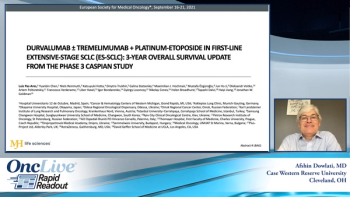
Afshin Dowlati, MD, discusses data from the following presentation: “Durvalumab ± tremelimumab + platinum-etoposide in first-line extensive-stage SCLC (ES-SCLC): 3-year overall survival update from the Phase 3 CASPIAN study.” (Paz-Ares, ESMO 2021, LBA61)

Ashish Saxena, MD, PhD, discusses a challenging case of a patient with non–small cell lung cancer.
Advertisement
Advertisement
Trending on OncLive
1
Five Under 5: Top Oncology Videos for the Week of 10/5/2026
2
Guardant360 CDx Receives European Approval as Companion Diagnostic for Camizestrant in ESR1-Mutated Advanced Breast Cancer
3
GI Cancer Monthly Rewind: Key News and Expert Insights You May Have Missed in September 2026
4
The OncFive: Top Oncology Articles for the Week of 10/4/2026
5