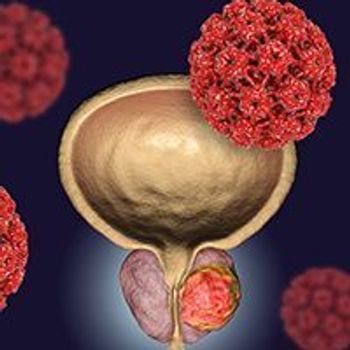
The addition of a recombinant pox-viral vector vaccine Panvac™ to bacillus Calmette-Guérin did not significantly improve clinical outcomes for patients with BCG-unresponsive non–muscle invasive bladder cancer.

Your AI-Trained Oncology Knowledge Connection!


The addition of a recombinant pox-viral vector vaccine Panvac™ to bacillus Calmette-Guérin did not significantly improve clinical outcomes for patients with BCG-unresponsive non–muscle invasive bladder cancer.

The investigational small molecule masitinib plus docetaxel resulted in a statistically significant 21% reduction in the risk of progression or death compared with placebo plus docetaxel in men with metastatic castration-resistant prostate cancer and baseline alkaline phosphatase levels of 250 IU/mL or less.

The addition of avelumab to Bacillus Calmette-Guerin induction therapy appeared to be safe and well tolerated in patients with BCG-unresponsive non–muscle invasive bladder cancer.

Smoking status is not often reported on genitourinary cancer clinical trials, which limits understanding of how smoking impacts the treatment, survival, and quality of life of this patient population.

The combination of olaparib and pembrolizumab continued to demonstrate antitumor activity in patients with metastatic castration-resistant prostate cancer who previously received docetaxel.

Steven Kaplan, MD, discusses real-world surgical retreatment rates in patients with lower urinary tract symptoms/benign prostatic hyperplasia.

Darolutamide was linked with a reduction in locally invasive procedures, delayed time to deterioration in health-related quality of life related to urinary and bowel symptoms in patients with nonmetastatic castration-resistant prostate cancer.

Enzalutamide plus androgen-deprivation therapy produced clinical benefit over ADT alone in patients with metastatic hormone-sensitive prostate cancer, regardless of prior antiandrogen therapy and its pretreatment duration.

Stephen B. Williams, MD, discusses the rationale for the phase 3 SunRISE-2 trial in muscle-invasive bladder cancer.

Patients with microsatellite instability–high or mismatch repair–deficient prostate cancer may be more likely to respond to treatment with checkpoint inhibitors compared with those who have high tumor mutational burden.

Cancer and Leukemia Group B prognostic risk group and the receipt of subsequent FDA-approved life-prolonging therapies may impact overall survival in patients with metastatic castration-resistant prostate cancer who are receiving lutetium 177.

Nadofaragene firadenovec, a novel intravesical gene therapy for patients with bacillus Calmette-Guérin unresponsive non–muscle invasive bladder cancer, demonstrated sustained durability according to findings from 2 cohorts of a phase 3 study.

Relugolix failed to significantly delay onset of castration resistance compared with standard of care leuprolide in men with advanced prostate cancer.

The combination of durvalumab and Vicineum was found to be well tolerated and to elicit complete responses in patients with Bacillus-Calmette Guérin–unresponsive non–muscle invasive bladder cancer.

Treatment with neoadjuvant lutetium prostate-specific membrane antigen followed by radical prostatectomy exhibited a favorable safety profile in patients with locally advanced high-risk prostate cancer.
TAR-200 plus cetrelimab may offer a superior treatment option for patients with muscle-invasive bladder cancer, and to answer this questions, investigators have initiated the randomized, phase 3 SunRISe-2 trial.

Primary tumor response to nivolumab plus ipilimumab observed results of a Japanese study indicates a changing role for the timing of cytoreductive nephrectomy for patients with advanced renal cell carcinoma.fr

Ashutosh K. Tewari, MD, discusses the benefits of robotic radical prostatectomy in prostate cancer.
Michael A. Palese, MD, discusses emerging technologies in benign prostatic hyperplasia.

Ketan K. Badani, MD, discusses the utility of multiport robotic retroperitoneal partial nephrectomies in renal cell carcinoma (RCC).

Bacille Calmette-Guérin (BCG) plus N-803 yielded promising responses and an encouraging safety profile in patients with BCG-unresponsive, non-muscle invasive bladder cancer carcinoma in situ.

Patients with nonmetastatic castration-resistant prostate cancer demonstrated high adherence rates and favorable prostate-specific antigen response to apalutamide according to real-world evidence presented at the 2021 American Urological Association Annual Meeting.

Antibody titers and fold changes may prove to be a prognostic marker for the efficacy of nadofaragene firadenovec for the treatment of patients with bacillus Calmette-Guérun unresponsive non-muscle invasive bladder cancer.

Obese men with metastatic castration-resistant prostate cancer have better disease-specific and overall survival than overweight or normal weight patients.