
Simultaneous targeting of Bruton’s tyrosine kinase and the CD20 antigen led to overall responses in more than 90% of patients with chronic lymphocytic leukemia, including untreated and relapsed/refractory disease.
Simultaneous targeting of Bruton’s tyrosine kinase and the CD20 antigen led to overall responses in more than 90% of patients with chronic lymphocytic leukemia, including untreated and relapsed/refractory disease.
Hope S. Rugo, MD, director, Breast Oncology and Clinical Trials Education, University of California San Francisco Helen Diller Family Comprehensive Cancer Center, discusses the phase III SOPHIA trial of margetuximab plus chemotherapy versus trastuzumab (Herceptin) plus capecitabine in patients with HER2-positive metastatic breast cancer after prior anti–HER2-targeted therapies.
Caroline Robert, MD, PhD, head of the Dermatology Unit in Gustave Roussy Cancer Center, Villejuif-Paris, France, discusses results of a 5-year analysis evaluating the long-term effects of dabrafenib (Tafinlar) and trametinib (Mekinist) in patients with BRAF V600–mutant unresectable or metastatic melanoma.

The PARP inhibitor olaparib reduced the risk of disease progression or death by 38% versus chemotherapy in patients with platinum-sensitive, relapsed, germline BRCA1/2-mutated ovarian cancer who received at least 2 prior lines of chemotherapy.

The addition of venetoclax to obinutuzumab reduced the risk for disease worsening or death by 65% compared with obinutuzumab plus chlorambucil in patients with previously untreated chronic lymphocytic leukemia.

A chemotherapy-free doublet for platinum-sensitive recurrent ovarian cancer more than doubled progression-free survival as compared with single-agent PARP inhibitor.

Two new therapies are showing encouraging findings for patients with NSCLC with either RET rearranged or EGFR exon 20 insertions, raising hope that 2 hard-to-target driver alterations may soon have an associated targeted treatment.
Paul G. Richardson, MD, clinical program leader and director of clinical research at the Jerome Lipper Multiple Myeloma Center at Dana-Farber Cancer Institute, discussed the phase III ICARIA-MM trial, which looked at the triplet regimen of isatuximab, pomalidomide (Pomalyst), and dexamethasone in patients with relapsed/refractory multiple myeloma.

The investigational KRASG12C inhibitor AMG 510 achieved a 50% response rate in patients with KRASG12C-positive advanced non–small cell lung cancer, according to results from a phase I study presented at the 2019 ASCO Annual Meeting.
Daniel P. Petrylak, MD, professor of medicine and urology at Yale Cancer Center, 2017 Giant of Cancer Care in Genitourinary Cancers, discusses the phase II EV-201 trial of enfortumab vedotin in patients with locally advanced or metastatic urothelial cancer who were previously treated with platinum-based chemotherapy or a PD-1/PD-L1 checkpoint inhibitor.

Patients with non–small cell lung cancer and baseline liver metastases had improved progression-free survival and overall survival with the addition of immunotherapy to bevacizumab and a chemotherapy doublet.

Two highly selective MET inhibitors, tepotinib and capmatinib showed promising clinical activity in the first- and second-line treatment of patients with MET exon 14-altered advanced non–small cell lung cancer.

Adding ramucirumab to erlotinib reduced the risk of disease progression or death by over 40% versus erlotinib alone as a frontline treatment for patients with EGFR-positive NSCLC.
The FDA has unveiled what it describes as a pilot “concierge service” for oncologists and patients seeking information and assistance with expanded access to investigational therapies.

Neoadjuvant immunotherapy demonstrated substantial activity with a favorable toxicity profile in findings from 2 studies of patients with operable early-stage non–small cell lung cancer reported at the 2019 ASCO Annual Meeting.

More than 70% of female gynecologic oncologists in the United States and more than half of male practitioners have experienced sexual harassment in training or practice, according to results from a survey conducted by the Society of Gynecologic Oncology.

Similar long-term rates of survival were seen in patients with colorectal cancer and liver metastases regardless of whether the patient underwent laparoscopic or open liver surgery.

A broader set of clinical trial eligibility criteria proposed by the American Society of Clinical Oncology and Friends of Cancer Research would nearly double the number of patients with advanced non-small cell lung cancer available for enrollment.
Enfortumab vedotin induced responses in 44% of patients with locally advanced or metastatic urothelial cancer, including 12% experiencing a complete response to treatment.
Talia Golan, MD, head of Sheba Pancreatic Cancer Center, discusses the results of the phase III POLO trial, which evaluated maintenance olaparib compared with placebo among patients with germline BRCA-mutated metastatic pancreatic cancer.
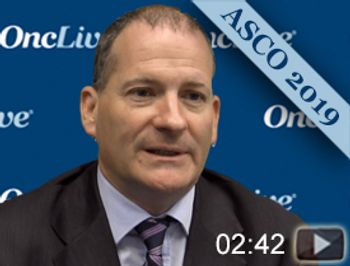
Christopher Sweeney, MBBS, medical oncologist at the Lank Center for Genitourinary Oncology, Dana-Farber Cancer Institute, discusses results of the phase III ENZAMET trial, which looked at standard therapy with or without enzalutamide as a treatment for patients with metastatic hormone-sensitive prostate cancer.
Adding isatuximab to pomalidomide and low-dose dexamethasone led to a greater than 40% reduction in the risk of disease progression or death compared with pomalidomide and dexamethasone alone in patients with relapsed/refractory multiple myeloma.

A subcutaneous flat-dose version of daratumumab demonstrated noninferior efficacy with a reduction in the treatment burden compared with the original intravenous formulation of the anti-CD38 monoclonal antibody for patients with relapsed/refractory multiple myeloma.

Examination of a cohort of patients with metastatic breast cancer and high mutational burden who were enrolled in the phase II Targeted Agent and Profiling Utilization Registry basket study shows that pembrolizumab monotherapy has antitumor activity in this population of heavily pretreated patients.

Lurbinectedin monotherapy achieved an overall response rate of 35.2% as a second-line treatment for patients with small cell lung cancer, according to findings from a phase II basket trial presented at the 2019 ASCO Annual Meeting.

Maintenance therapy with olaparib significantly improved progression-free survival compared with placebo among patients with germline BRCA-mutated metastatic pancreatic cancer.
Almost 80% of men with metastatic hormone-sensitive prostate cancer treated with enzalutamide plus standard of care (SOC) were alive after 3 years compared with 72% of patients who received a different non-steroidal anti-androgen plus SOC.

Higher income was associated with significantly greater probability of survival for patients with multiple myeloma, according to authors of a study they performed to call attention to the need to address socioeconomic disparities that influence treatment outcomes.
The expansion of Medicaid nearly eliminated racial disparities in time to cancer treatment.

Pre-Medicare-aged women with ovarian cancer were more likely to be diagnosed at an early stage and receive treatment within 30 days of diagnosis after passage of the Affordable Care Act than before.