Dr. Wistuba emphasizes the critical need for reinforcing RNA testing alongside DNA testing for comprehensive NGS in lung cancer.

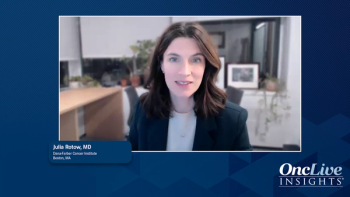
Julia Rotow, MD, is a physician, clinical director of the Lowe Center for Thoracic Oncology, and director of Clinical Research at Dana-Farber Cancer Institute, as well as an assistant professor of medicine at Harvard Medical School.

Dr. Wistuba emphasizes the critical need for reinforcing RNA testing alongside DNA testing for comprehensive NGS in lung cancer.

Dr. Leal outlines her approach to frontline treatment selection for newly diagnosed patients with ROS1-positive lung cancer.

Dr. Rodriguez outlines patient education strategies emphasizing partnership from treatment initiation, as clinical trials demonstrate over half of patients require dose adjustments.

Dr. Rodriguez reviews historical toxicity profiles from earlier ROS1 inhibitors, noting that crizotinib and entrectinib presented novel side effects including visual field changes preventing night driving due to floaters, along with liver function test (LFT) abnormalities requiring monitoring.

Dr. Wistuba explains that acquired resistance to ROS1-targeted therapies frequently involves on-target mutations, with G2032R representing the most frequently observed resistance mutation among 10 to 12 described mutations that affect the ATP binding site and reduce drug binding efficiency.

Dr. Wistuba addresses the complexity of NGS reports that may include multiple abnormalities beyond ROS1 fusions.

Dr. Wistuba confirms that fusion variant identification does not impact treatment selection, emphasizing that ROS1-positive versus ROS1-negative status represents the key clinical decision point.

Dr. Wistuba provides detailed information about ROS1 gene fusions, discovered in the 1980s with over 30 to 40 fusion partners identified that constitutively activate ROS1 in cells, leading to malignant properties.

Dr. Leal emphasizes that although actionable genomic alterations like ROS1 are rare, their clinical implications are enormous. Following National Comprehensive Cancer Network (NCCN) guidelines, these targets should be acted upon in the first-line setting as the initial targeted therapy treatment.

Drs Rotow and Dietrich discuss the significance of the accelerated FDA approval of zongertinib (Hernexeos) for patients with HER2 TKD–mutated NSCLC.

Panelists discuss the role of ctDNA (liquid biopsy) in clinical practice, highlighting its benefits and limitations in detecting actionable mutations, interpreting results, and guiding treatment decisions when tissue testing is insufficient.

Panelists discuss strategies for identifying and managing ROS1-positive NSCLC, focusing on comprehensive testing approaches, emerging clinical data, and factors that guide treatment decisions.

Panelists discuss treatment selection, resistance challenges, and future directions in managing BRAF-mutated lung cancer.

Panelists discuss the latest trial results supporting dual-pathway inhibition in BRAF-mutated metastatic lung cancer.

Drs Rotow and Woodard talk through recent updates to the perioperative non–small cell lung cancer treatment paradigm.

Panelists discuss combination targeted approaches for managing BRAF-mutated lung cancer and their impact on disease durability.

Panelists discuss evolving treatment approaches for BRAF-mutated metastatic lung cancer and their clinical impact.

Explore a case study on HER2 mutant lung cancer treatment, highlighting challenges, responses, and the importance of monitoring for ILD.

Panelists discuss the biology and clinical implications of BRAF mutations in non–small cell lung cancer (NSCLC).

Panelists discuss individualized treatment selection based on age, comorbidities, and patient preferences in ALK-positive lung cancer.

Explore a case study on HER2 mutant lung cancer treatment, highlighting challenges, responses, and the importance of monitoring for ILD.

Explore a case study on HER2 mutant lung cancer treatment, highlighting challenges, responses, and the importance of monitoring for ILD.

Panelists discuss novel research directions aimed at overcoming resistance and extending survival in ALK-positive lung cancer.

Panelists discuss mechanisms of acquired resistance to ALK inhibition and how molecular testing guides sequencing strategies.

Explore a case study on HER2 mutant lung cancer treatment, highlighting challenges and responses to chemotherapy and immunotherapy.

Explore a case study on HER2 mutant lung cancer treatment, highlighting challenges, responses, and the importance of monitoring for ILD.

Panelists discuss how real-world data complement clinical trials in understanding outcomes for ALK-positive lung cancer.

Panelists discuss how mature survival data inform treatment sequencing and maintenance strategies in ALK-positive lung cancer.

Explore a case study on HER2 mutant lung cancer treatment, highlighting challenges and responses to therapy in a patient with metastatic disease.

Explore innovative strategies for testing and treating HER2 alterations in non-small cell lung cancer through real-world case studies and expert insights.

March 17th 2025

September 22nd 2025

November 5th 2025

November 5th 2025

April 20th 2026