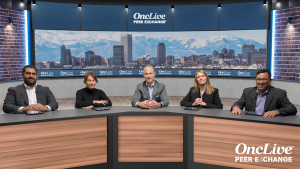
Explore the evolving role of Trop-2 in non-small cell lung cancer and the importance of larger studies and biomarkers for future treatments.

Your AI-Trained Oncology Knowledge Connection!


Benjamin P. Levy, MD, is clinical director of Medical Oncology at Johns Hopkins Sidney Kimmel Cancer Center at Sibley Memorial Hospital and associate professor of oncology at Johns Hopkins University School of Medicine.

Explore the evolving role of Trop-2 in non-small cell lung cancer and the importance of larger studies and biomarkers for future treatments.

Recent studies on Trop2-ADC reveal promising predictive biomarkers for lung cancer treatment, sparking excitement while urging caution for further research.

Discover the groundbreaking QCS method for measuring Trop-2 in lung cancer, enhancing accuracy and objectivity in biomarker assessment.

Exploring the complexities of Trop-2 expression in cancer, this discussion highlights challenges in measurement and its implications for treatment efficacy.

Explore the evolving role of Trop-2 in non-small cell lung cancer, including measurement techniques and emerging therapeutic insights.

Benjamin P. Levy, MD leads a live CFS discussion with Kamel Abou Hussein, MD and Victoria Rizk, MD on the evolving therapeutic landscape in breast cancer.

Benjamin P. Levy, MD, and Jonathan W. Lee, MD, MSc discuss advances in EGFR-Mutant, HER2-Positive, and Oncogene-Driven NSCLC Highlighted at CFS.

Drs Levy and Tagawa discuss the rapidly evolving treatment paradigms for prostate cancer and RCC live at the 43rd Annual Chemotherapy Foundation Symposium.

Lung cancer experts discuss successes and hesitations regarding the evolving use of antibody-drug conjugates in non–small cell lung cancer.

Panelists discuss how treatment decisions for advanced non–small cell lung cancer (NSCLC) without actionable mutations depend on factors like PD-L1 status, histology (eg, squamous [SQ]), and biomarkers like STK11/KEAP1. Chemotherapy may be added based on individual patient factors, with promising advancements expected in 2025.

Panelists discuss how emerging data on novel HER2-targeted agents, including Beamion LUNG-1 (zongertinib) and SOHO-1 (BAY 2927088), show promise for advanced non–small cell lung cancer (NSCLC). Additionally, the eNRGy trial and FDA approval of zenocutuzumab for NRG1 fusion–positive non–small cell lung cancer (NSCLC) offers new treatment avenues. Patient selection will depend on genetic profiling and treatment efficacy.

Panelists discuss how treatment decisions for advanced non–small cell lung cancer (NSCLC) without actionable mutations depend on factors like PD-L1 status, histology (eg, squamous [SQ]), and biomarkers like STK11/KEAP1. Chemotherapy may be added based on individual patient factors, with promising advancements expected in 2025.

Panelists discuss how emerging data on novel HER2-targeted agents, including Beamion LUNG-1 (zongertinib) and SOHO-1 (BAY 2927088), show promise for advanced non–small cell lung cancer (NSCLC). Additionally, the eNRGy trial and FDA approval of zenocutuzumab for NRG1 fusion–positive non–small cell lung cancer (NSCLC) offers new treatment avenues. Patient selection will depend on genetic profiling and treatment efficacy

Panelists discuss how the 5-year follow-up data from the CROWN trial support lorlatinib as a frontline treatment for ALK-positive non–small cell lung cancer NSCLC with brain metastasis. For frontline therapy, starting at full dose is preferred, adjusting if needed. Post progression, lorlatinib can be continued or combined with other agents. Biomarker testing for ROS1 is essential, with recent data (TRIDENT-1 trial) favoring lorlatinib for ROS1-positive central nervous system (CNS) involvement. Novel agents like taletrectinib and zidesamtinib from TRUST-I/II and ARROS-1 trials show promise in expanding treatment options for ROS1-positive NSCLC.

Panelists discuss how MARIPOSA-2 (Popat S, et al, ESMO 2024) and the September 2024 FDA approval of amivantamab plus chemo as a second-line option highlight advances in non–small cell lung cancer (NSCLC) treatment. Strategies involve sequencing with emerging therapies like HERTHENA-Lung01, addressing resistance, and central nervous system (CNS) metastases. The complete response letter (CRL) for HER3-DXd and the shift in biologics license application (BLA) status for Dato-DXd from TROPION-Lung05 (Lisberg A, et al, ASCO 2024) will shape clinical practices and resistance management moving forward.

Panelists discuss how the 5-year follow-up data from the CROWN trial support lorlatinib as a frontline treatment for ALK-positive non–small cell lung cancer NSCLC with brain metastasis. For frontline therapy, starting at full dose is preferred, adjusting if needed. Post progression, lorlatinib can be continued or combined with other agents. Biomarker testing for ROS1 is essential, with recent data (TRIDENT-1 trial) favoring lorlatinib for ROS1-positive central nervous system (CNS) involvement. Novel agents like taletrectinib and zidesamtinib from TRUST-I/II and ARROS-1 trials show promise in expanding treatment options for ROS1-positive NSCLC.

Panelists discuss how MARIPOSA-2 (Popat S, et al, ESMO 2024) and the September 2024 FDA approval of amivantamab plus chemo as a second-line option highlight advances in non–small cell lung cancer (NSCLC) treatment. Strategies involve sequencing with emerging therapies like HERTHENA-Lung01, addressing resistance, and central nervous system (CNS) metastases. The complete response letter (CRL) for HER3-DXd and the shift in biologics license application (BLA) status for Dato-DXd from TROPION-Lung05 (Lisberg A, et al, ASCO 2024) will shape clinical practices and resistance management moving forward.

Panelists discuss how the MARIPOSA trial (ASCO 2024) showed improved overall survival (OS) with amivantamab plus lazertinib vs osimertinib in first-line EGFR-mutant non–small cell lung cancer (NSCLC), supporting its FDA approval (October 2024). This regimen may become standard of care for select patients, but osimertinib with or without chemo remains vital. The complete response letter (CRL) for subcutaneous amivantamab may delay uptake.

Panelists discuss how osimertinib has been approved for patients with unresectable, EGFR-mutated stage III non–small cell lung cancer (NSCLC) following chemoradiation, based on the LAURA trial, which demonstrated a significant improvement in progression-free survival. In clinical practice, osimertinib is administered as consolidation therapy until disease progression or unacceptable toxicity. Ongoing studies like PACIFIC-9 and PACIFIC-8 are exploring the efficacy of combining durvalumab with other agents, potentially influencing future chemo-immunotherapy strategies in advanced NSCLC.

Panelists discuss how the MARIPOSA trial (ASCO 2024) showed improved overall survival (OS) with amivantamab plus lazertinib vs osimertinib in first-line EGFR-mutant non–small cell lung cancer (NSCLC), supporting its FDA approval (October 2024). This regimen may become standard of care for select patients, but osimertinib with or without chemo remains vital. The complete response letter (CRL) for subcutaneous amivantamab may delay uptake.

Panelists discuss how osimertinib has been approved for patients with unresectable, EGFR-mutated stage III non–small cell lung cancer (NSCLC) following chemoradiation, based on the LAURA trial, which demonstrated a significant improvement in progression-free survival. In clinical practice, osimertinib is administered as consolidation therapy until disease progression or unacceptable toxicity. Ongoing studies like PACIFIC-9 and PACIFIC-8 are exploring the efficacy of combining durvalumab with other agents, potentially influencing future chemo-immunotherapy strategies in advanced NSCLC.

Panelists discuss how, in clinical practice, ADAURA (osimertinib) and ALINA (alectinib) are integrated based on EGFR/ALK status, stage, and recurrence risk. Adjuvant therapy duration is typically 3 years. Circulating tumor DNA (ctDNA), minimal residual disease (MRD) from ADAURA (ASCO 2024, Abs 8005) may refine treatment decisions by detecting MRD.

Panelists discuss how recent data from KEYNOTE-671, AEGEAN, and CheckMate 77T reinforce neoadjuvant therapy’s efficacy in early-stage non–small cell lung cancer (NSCLC), showing consistent survival benefits. In contrast, adjuvant data remain conflicting, limiting its role. Neoadjuvant therapy should be prioritized, with adjuvant therapy reserved for select high-risk patients.

Panelists discuss how emerging antibody-drug conjugate (ADC) data from TROPiCS-03 and IDeate-Lung01 suggest potential in extensive-stage small cell lung cancer (ES-SCLC), impacting sequencing with current therapies. T-cell engagers like BI 764532 and HPN328 may reshape treatment. MRI surveillance, per retrospective data and MAVERICK, offers an alternative to prophylactic cranial irradiation (PCI), though select factors may still justify PCI use.

Panelists discuss how the DeLLphi-301 trial demonstrated that tarlatamab, administered biweekly at a 10 mg dose, achieved a 40% objective response rate in patients with previously treated extensive-stage small cell lung cancer (ES-SCLC). This led to its accelerated FDA approval in May 2024. Integrating tarlatamab into clinical practice may present challenges, including managing cytokine release syndrome and neurologic toxicities, as well as addressing financial considerations.

Panelists discuss how recent real-world data comparing atezolizumab and durvalumab in extensive-stage non–small cell lung cancer (ES-NSCLC) informs treatment selection, though direct comparisons remain limited. Lurbinectedin is a key second-line option, with emerging combination strategies.

Panelists discuss how the ADRIATIC regimen integrates immunotherapy post-chemoradiation in late-stage small cell lung cancer (LS-SCLC). In patients with paraneoplastic syndromes or immune disorders, immunotherapy requires caution. Prophylactic cranial irradiation (PCI) is considered for high-risk cases, while MRI surveillance is preferred for select patients to reduce neurotoxicity.

Panelists discuss how, in clinical practice, ADAURA (osimertinib) and ALINA (alectinib) are integrated based on EGFR/ALK status, stage, and recurrence risk. Adjuvant therapy duration is typically 3 years. Circulating tumor DNA (ctDNA), minimal residual disease (MRD) from ADAURA (ASCO 2024, Abs 8005) may refine treatment decisions by detecting MRD.

Panelists discuss how recent data from KEYNOTE-671, AEGEAN, and CheckMate 77T reinforce neoadjuvant therapy’s efficacy in early-stage non–small cell lung cancer (NSCLC), showing consistent survival benefits. In contrast, adjuvant data remain conflicting, limiting its role. Neoadjuvant therapy should be prioritized, with adjuvant therapy reserved for select high-risk patients.

Panelists discuss how emerging antibody-drug conjugate (ADC) data from TROPiCS-03 and IDeate-Lung01 suggest potential in extensive-stage small cell lung cancer (ES-SCLC), impacting sequencing with current therapies. T-cell engagers like BI 764532 and HPN328 may reshape treatment. MRI surveillance, per retrospective data and MAVERICK, offers an alternative to prophylactic cranial irradiation (PCI), though select factors may still justify PCI use.

Published: July 24th 2020 | Updated:

Published: November 3rd 2023 | Updated:

Published: August 2nd 2022 | Updated:

Published: December 15th 2023 | Updated:

Published: December 15th 2023 | Updated:

Published: December 27th 2023 | Updated: