



Lung Cancer
Latest News
Advertisement
Latest Videos































































Advertisement
More News
The FDA has granted orphan drug designation to CID-078 for the treatment of patients with small cell lung cancer.

The top 5 OncLive videos of the week cover insights in non–small cell lung cancer, small cell lung cancer, and breast cancer.
The FDA has approved new options in head and neck cancer, lung cancer, and bladder cancer—and more from OncLive this week.

TT125-802 demonstrated early clinical activity and a favorable safety profile in advanced solid tumors.
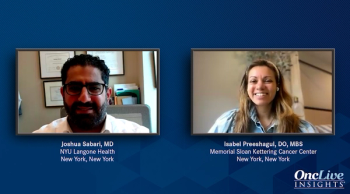
Panelists discuss how sequencing strategies for multiple HER2-targeted therapies will require careful consideration of patient characteristics, disease burden, and prior treatments, with oral tyrosine kinase inhibitors potentially preferred first due to better tolerability and CNS activity, while combination approaches remain investigational pending safety and efficacy data.
Panelists discuss how emerging oral tyrosine kinase inhibitors like zongertinib (HER2-selective) and sevabertinib (HER2/EGFR dual inhibitor) offer promising alternatives to antibody-drug conjugates with improved tolerability profiles, better central nervous system penetration, and robust response rates in the 60% to 70% range for second-line treatment.
Panelists discuss how interstitial lung disease represents a critical and potentially cryptic toxicity occurring in 10% to 15% of patients receiving HER2 antibody-drug conjugates, requiring vigilant monitoring, prompt recognition of subtle symptoms like dry cough, and aggressive management with steroids and pulmonary consultation.
Panelists discuss how antibody drug conjugates like trastuzumab deruxtecan work as “Trojan horses” to deliver chemotherapy directly to tumor cells, providing effective second-line treatment for patients with HER2-mutated disease but requiring careful management of chemotherapy-like adverse effects, including significant toxicities.
Panelists discuss how patients with HER2-mutated lung cancer represent a high-risk population with aggressive biology and propensity for brain metastases, currently treated with standard chemotherapy in the frontline setting while awaiting clinical trials that may move HER2-targeted agents to first-line treatment.
Panelists discuss how comprehensive next-generation sequencing testing is essential for identifying HER2 mutations in patients with stage IV non–small cell lung cancer, distinguishing between HER2 mutations (detected by DNA sequencing) and HER2 overexpression/amplification (detected by immunohistochemistry).
Tomasz Jankowski, MD, PhD, discusses THIO sequenced with cemiplimab for the third-line treatment of patients with ICI-resistant advanced NSCLC.

The oncolytic virus candidate MVdeltaC has received FDA orphan drug designation for the treatment of patients with pleural mesothelioma.
Panelists discuss how medical professionals envision the future of early-stage non–small cell lung cancer (NSCLC) treatment evolving through the integration of novel therapies, predictive biomarkers, and personalized strategies to address current gaps in care, emphasizing the need for continued research to optimize outcomes and tailor interventions in resectable disease.
Martin E. Gutierrez, MD, discusses data for Dato-DXd plus rilvegostomig in advanced or metastatic NSCLC.
Miguel Gonzalez Velez, MD, discusses the role of tarlatamab as a second-line treatment for small cell lung cancer.
Nathan A. Pennell, MD, PhD, discusses the significance of the FDA approval of taletrectinib for ROS1-positive non-small cell lung cancer.
Li Zhang, MD, discusses sacituzumab tirumotecan in patients with previously treated, advanced EGFR-mutated non–small cell lung cancer.
The FDA has approved taletrectinib for use in patients with ROS1-positive advanced non–small cell lung cancer.

China’s Center for Drug Evaluation granted breakthrough therapy designation to sacituzumab tirumotecan for nonsquamous non–small cell lung cancer.
The FDA granted priority review to the sNDA seeking the approval of the first-line maintenance combination of lurbinectedin and atezolizumab for ES-SCLC.

Suresh S. Ramalingam, MD, FACP, FASCO, highlights his journey in the lung cancer field, leading up to his recognition on the TIME100 Health 2025 list.
The top oncology videos of the week for the week of June 1, 2025, including updates from the 2025 ASCO Annual Meeting.
RET rechallenge following disease progression demonstrated greater efficacy with select combination therapies targeting bypass resistance vs single agents.
Panelists discuss how targeted therapy with osimertinib has revolutionized treatment approaches for unresectable early-stage non–small cell lung cancer (NSCLC) patients with EGFR mutations, offering new hope for a previously underserved patient population.
Panelists discuss how PD-L1 expression levels significantly impact treatment decisions in unresectable early-stage non–small cell lung cancer (NSCLC), with consensus that biomarker status should be evaluated before finalizing treatment approaches.
Advertisement
Advertisement
Trending on OncLive
1
FDA Approves Tucatinib Plus Trastuzumab/Pertuzumab as First-Line Maintenance in Advanced HER2+ Breast Cancer
2
VIR-5500 Receives FDA Fast Track Designation in mCRPC
3
Iberdomide Plus Daratumumab/Dexamethasone Yields Significant PFS Benefit in R/R Myeloma
4
FDA Approves Atezolizumab Plus Chemo for Stage III dMMR Colon Cancer
5